
Ten Teams, One State, One Vacuum: The Inside Arithmetic of the Kabaddi Champions League Expansion
সারসংক্ষেপ: কাবাড্ডি চ্যাম্পিয়ন্স লীগ আট দল থেকে দশ দলে সম্প্রসারিত হয়েছে, নিলামের থলি পাঁচ কোটি রুপি এবং নিলাম-পুলে তিনশোর বেশি খেলোয়াড়। তবে দশটি ফ্র্যাঞ্চাইজির সবই হরিয়ানার শহরভিত্তিক, ফলে এটি জাতীয় বা International লীগ নয় — একটি আঞ্চলিক দ্বিতীয় সারির প্রতিযোগিতা। এর সম্প্রসারণের মূল চালিকাশক্তি প্রো কাবাড্ডি লীগের ত্রয়োদশ আসরের বিলম্ব, যা সম্প্রচার-স্বত্ব সংকটের কারণে জুন-জুলাই ২০২৭-এ ঠেলে দেওয়া হয়েছে। শীর্ষ নিলাম-দাম ১৭ দশমিক ৪ লক্ষ রুপি (আয়ান লোচাব, ঝাঝার জাগুয়ারস), যা দলীয় থলির তুলনায় এতই কম যে বোঝা যায় থলির পুরো টাকা খরচ হয় না — অর্থাৎ পাঁচ কোটি রুপি মূলত ঘোষণামূলক সংখ্যা, প্রকৃত বাজেট নয়। সবচেয়ে বিশ্বাসযোগ্য ইতিবাচক সংকেত সোনিপতে ৬,৪০০-র বেশি বাছাইপর্ব Articlesন, যা বাস্তব তৃণমূল চাহিদা দেখায়, কিন্তু যাচাইকৃত প্রতিভার প্রমাণ নয়। প্রধান ঝুঁকি তিনটি: সম্প্রচার ও পৃষ্ঠপোষকতার আয় সম্পূর্ণ অপ্রকাশিত, খেলোয়াড়দের প্রকৃত বেতন অত্যন্ত কম, এবং ফেডারেশন-অনুমোদন ও মালিকানা অস্পষ্ট। 'চ্যাম্পিয়ন্স লীগ' নামটি অতিরঞ্জিত; দশ দলের সবই হরিয়ানার। ভবিষ্যতে নজরে রাখার সংকেত: প্রো কাবাড্ডি লীগের নতুন মিডিয়া চুক্তি, চ্যাম্পিয়ন্স লীগের নিজস্ব সম্প্রচার চুক্তি, দ্বিতীয় মরসুমের ফলাফল, এবং ফেডারেশন-অনুমোদনের Status।
A Numbers-Driven Announcement, and the Questions Beneath It
The Kabaddi Champions League is expanding to ten franchises, all of them named after towns in the Indian state of Haryana. The purse has risen to five crore rupees per team, the auction pool exceeds three hundred players, and central trials in Sonipat drew more than 6,400 registrations. On first reading, these figures suggest a rising new force in India's kabaddi market.
Read together and checked against each other, they tell a different story. The expansion is not evidence of national growth. It is a regional, second-tier competition whose growth is taking place in the shadow of a broadcast-rights vacuum at the top of the sport.
Kabaddi, Explained from Zero
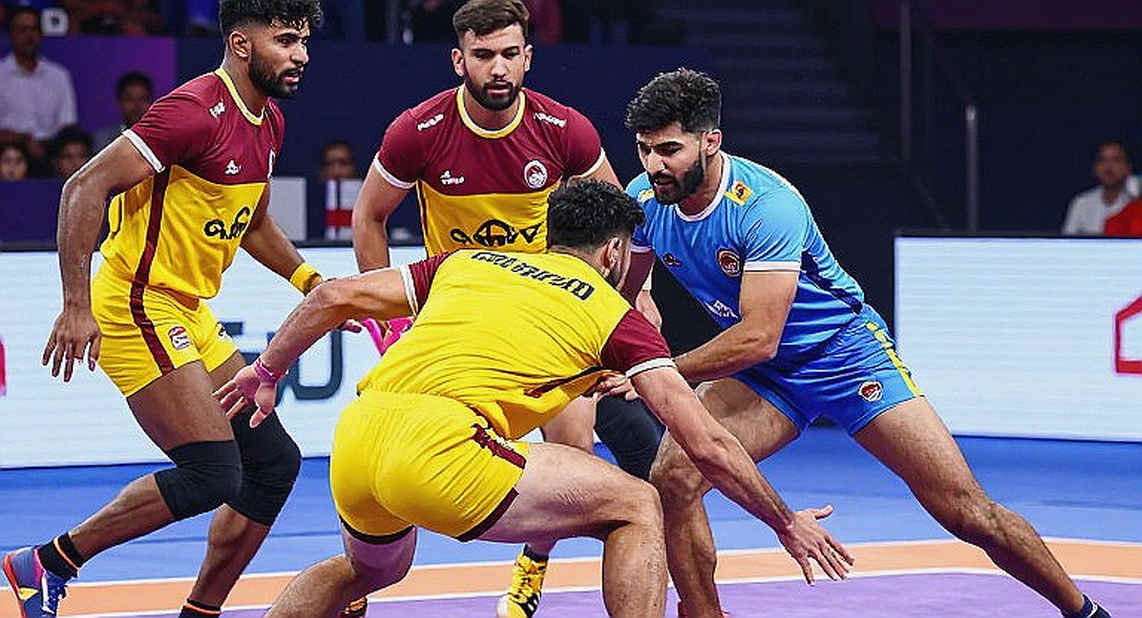
Kabaddi is a roughly four-thousand-year-old South Asian contact sport, often described to outsiders as a competitive version of a children's chasing game combined with wrestling. The critical difference from wrestling is that offence and defence are strictly separated in time.
- Raid: A designated attacker crosses into the opponent's half and has thirty seconds to touch one or more defenders and return safely. Each touch is worth a point. This is the only way to score proactively.
- Cant: Throughout the raid the raider must chant kabaddi, kabaddi continuously, proving he is not inhaling. If the chant breaks, the raid is void and the raider is out. This is the sport's most distinctive rule and the source of its lung-burning endurance demands.
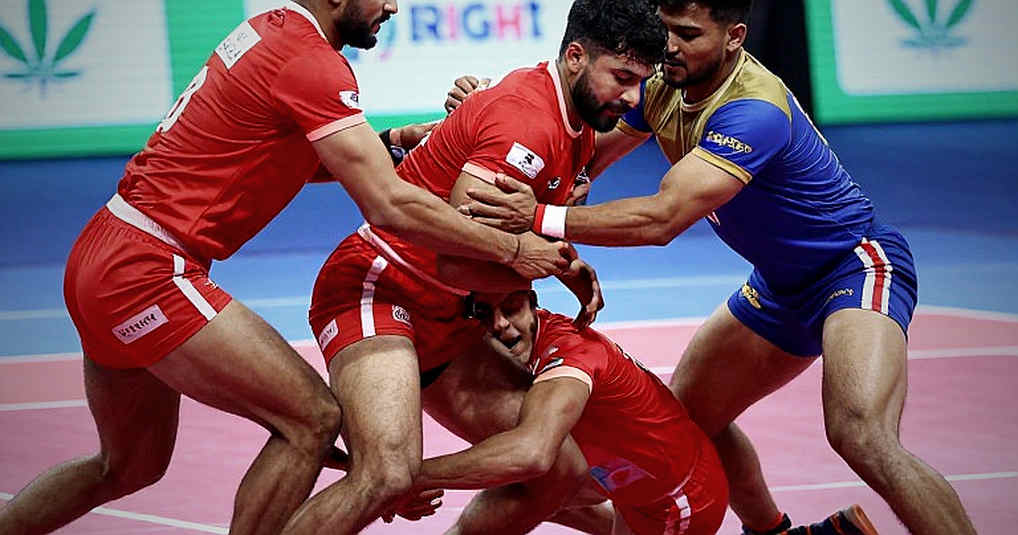
- Tackle: The seven defenders try to physically stop the raider inside their half. A successful tackle scores a point and sends the raider off.
- All Out: When an entire side is ruled out at once, the opponent gets two bonus points and the eliminated team revives on court. This produces rapid momentum reversals.
- Do-or-Die Raid: After two consecutive empty raids, the third becomes mandatory scoring; failure means automatic dismissal.
- Bonus Line: A line deep in the opponent's half; crossing it earns a point when six or more defenders are on court.
Kabaddi has two main variants. Standard Style, played on a mat with seven-a-side teams, is the professional and international format. Circle Style, associated with rural Punjab and played on a round field, is tactically a different game. The Champions League announcement never states which ruleset it uses. Given that it recruits players from the Pro Kabaddi League ecosystem, Standard Style is almost certain — but the absence of a stated ruleset is a genuine information gap, not a trivial omission.
Ten Teams, One State
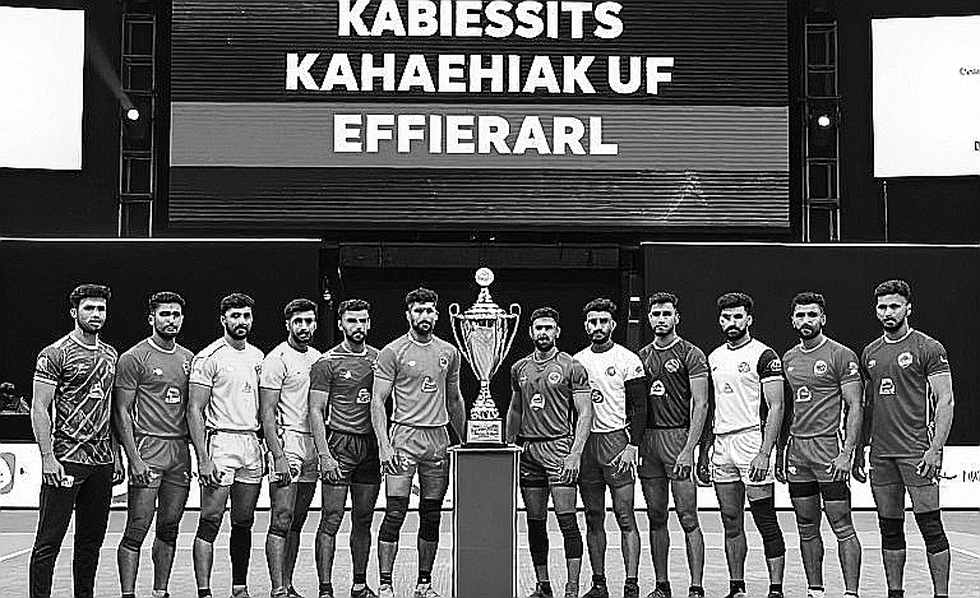
The expansion takes the league from eight franchises to ten. The two new entrants are Jhajjar Jaguars and Kurukshetra Knights. The other eight carry the names of Bhiwani, Rohtak, Karnal, Gurugram, Sonipat, Panipat, Faridabad and Hisar.
Every single franchise is a Haryana city. The Champions League branding implies a national or international scope that the entity does not have. Haryana is, however, a genuine kabaddi heartland — a rural belt whose traditional mud training grounds have supplied a disproportionate share of Pro Kabaddi League talent. The league sits on a real competitive region, but its footprint is state-level, not national.
The geographic concentration may itself be deliberate strategy rather than marketing oversight: keeping all teams inside one state minimises travel costs, simplifies local sponsorship, and taps a dense talent pool quickly. But whatever the rationale, it caps the league's national commercial ceiling.
The Auction: A Five-Crore Purse and What It Actually Buys
Currency first: one crore equals ten million rupees; one lakh equals one hundred thousand rupees. Five crore is roughly six hundred thousand US dollars. The top auction price of 17.4 lakh rupees is roughly twenty thousand dollars.
Now a calculation the announcement never performs. If all ten teams spent their full five crore purse and signed three hundred players between them, the total wage bill would be fifty crore rupees and the average player would earn roughly 16.7 lakh rupees — almost exactly the top price. In other words, the most expensive player would be an average player.
But a kabaddi squad is normally twelve to fifteen players, not thirty. At fifteen players per team, five crore rupees implies an average of about 33 lakh rupees — nearly double the highest price paid. That is arithmetically impossible. The only coherent explanation is that franchises spend only a fraction of their purse, perhaps ten to twenty percent.
The five crore figure is therefore a headline, not a binding budget. It makes the league look substantial without constraining actual spending. That matters, because it means nearly everything about the league's real economics remains unknown.
Players: Names, Prices and an Uncomfortable Gap
The top prices were: Ayan Lochab, 17.4 lakh rupees, to Jhajjar Jaguars; Bharat Hooda, 16.6 lakh, to Karnal Kings; Naveen Goyat, 15.2 lakh, to Kurukshetra Knights; followed by Singroha at 11 lakh and Sunil Malik at 10 lakh to Faridabad Fighters.
Here is the unanswered question. Sunil Malik is described as India's Asian Games captain — yet he was signed for less than the top price and less than three other players. If he genuinely captains the national side, this is a striking name discount. Three explanations are possible: he is a defensive or utility player whom the market undervalues relative to flair raiders; age or form has declined; or the honour refers to a specific past edition rather than the current senior squad.
The third possibility deserves the most scrutiny, because readers will naturally assume the title means the sitting national captain. The claim should be flagged as pending verification.
More broadly, auction prices are a weak proxy for quality. They reflect scarcity, local franchise strategy and bidding pressure, not output. The report contains no raid efficiency, tackle success rate or point-distribution data, so tactical assessment is impossible. The highest-price label is a marketing device, not a quality ranking.
The most credible figure in the entire story is the trial funnel: more than 6,400 registrations in Sonipat and 650 in Rohtak. But registrations are not screened talent. This signals genuine grassroots interest, not a proven talent pipeline.
Why Now: The Real Driver
The most important strategic fact is not in the auction numbers but in the calendar. The Pro Kabaddi League's thirteenth season has reportedly been pushed to June-July 2027 because its broadcast-rights arrangement expired and a new media partner has not been secured.
The Champions League is expanding precisely when the only commercially proven kabaddi product in India is in uncertainty. The expansion is best read as arbitrage on that vacuum, not organic growth. When the top league's schedule is unclear, players have time, franchises have opportunity, and there is a gap in audience attention that a smaller league can fill cheaply.
The vulnerability is inherent. The league's growth is a symptom of instability at the top, not proof of vitality at the second tier. If the Pro Kabaddi League secures a new broadcast partner and restarts in mid-2027, the Champions League's strategic rationale weakens sharply.
Haryana: Where Kabaddi Is a Social Ladder
Haryana, together with neighbouring belts, is one of India's largest suppliers of kabaddi and wrestling talent. Traditional akhadas — mud training grounds — have produced athletes for generations. For poor rural families, kabaddi and wrestling are genuine routes to class mobility: quotas and recruitment in the railways, police and army, plus Pro Kabaddi League contracts.
That social base is why the league can run ten teams on a five crore purse and still find three hundred auctionable players from six thousand trial registrations. The culture subsidises the economics.
The league's genuine emotional asset is the change-one's-fate narrative — but the announcement does not develop it, focusing instead on structure and prices. The risk is that extreme geographic concentration exposes the league to a single-region shock and limits national sponsorship appeal.
Commercial Health: The Biggest Blank
No broadcast revenue is disclosed. No sponsorship revenue is disclosed. No viewership, attendance or ticketing data exists. What is disclosed is a higher purse and a list of prices.
The absence of any broadcast partner in a league-expansion announcement is notable. It suggests either no national media deal exists, with distribution likely digital or regional, or that revenue depends on local sponsorship and owner goodwill.
The top price is roughly one-thirtieth of the team purse, implying purses are far from exhausted. Unlike the Pro Kabaddi League, this league's prices are too small to create a fame-premium bubble. The real commercial asset is the intake funnel, not the stars.
Internationally, the league has zero footprint. A separate and distinct story concerns plans for a World Cup and a women's league; those should not be conflated with this league's reach.
Governance: The Questions Nobody Asked
A league expanding to ten teams and raising its purse would normally name its sanctioning body. This one does not. Not disclosed: the operator, the relationship with the Amateur Kabaddi Federation of India or the International Kabaddi Federation, athlete contracts and welfare policy, anti-doping measures, officiating standards, or the ruleset itself.
That silence is the finding. A league recruiting more than three hundred players, many from rural backgrounds with limited bargaining power, raises labour-standard and welfare questions that the announcement never surfaces. If the league is unsanctioned, it could create parallel, uncoordinated structures — a development risk for the sport.
Risk Map
Commercial: high. Costs are announced; revenues are unknown. Sustainability must be treated as unproven.
Labour and professionalisation: high. Three hundred players on a five crore purse implies very low wages and limited injury protection.
Strategic dependence: high. The league's existence is partly contingent on the top tier's delay.
Governance opacity: medium. Ownership and sanctioning are undisclosed.
Name inflation: medium. Champions League branding overstates a one-state competition.
Competitive immaturity: medium. No first-season baseline exists by which to judge season two.
Overall: medium-high.
Narrative and the Expectation Gap
The article's tone is structural and neutral, which is a point in its favour. But four gaps persist. Scale is real but regionally siloed. Depth of player pool is real but quality is unverified. Purse growth suggests momentum but no revenue data exists. The Champions League name implies national status that the all-Haryana field does not meet.
The durable, honest narrative is simpler: second-tier kabaddi is filling a void left by top-tier mismatch. That is modest but true, and its lifespan is tied to the Pro Kabaddi League's scheduling resolution.
Industry Transmission
The Pro Kabaddi League proved in 2026 that a local niche sport, entertainment packaging, an auction model and prime-time broadcast could combine into a viable Indian league, spawning imitators in badminton, wrestling, volleyball and table tennis. The Champions League is a third wave: not a new sport league but a copier and feeder of the Pro Kabaddi League, operating at a fraction of its scale.
Its most genuine contribution is talent-chain maintenance. With the top league paused, six thousand trial registrations keep the rural pipeline warm, which benefits the national team and the top league later. That is a real positive externality — but it is an inference, not something the announcement states.
Conclusion
This is the expansion of a genuinely grassroots but geographically siloed Haryana second-tier kabaddi league, enabled opportunistically by the Pro Kabaddi League's broadcast vacuum. It is not evidence of a thriving national kabaddi market.
Its real assets are the deep Haryana talent pool and the price discovery of a low-cost player market. Its real risks are an undisclosed revenue model, very low implied wages, and governance opacity.
The single most important error a lay reader could make is to read the expansion as a national or international growth signal. It is a regional league expanding into a gap left by the top tier's uncertainty — a real phenomenon, with durability and scale still unproven.
Four signals to track: resolution of the Pro Kabaddi League's thirteenth-season media rights; any broadcast or sponsorship deal of the Champions League's own; season-two results and viewership; and federation sanctioning status.
This is a sports analysis based on public information and does not constitute betting advice. Match outcomes are highly uncertain, and the underlying figures carry limited source verification.