
The Story Before Do-or-Die: Three Quiet Signals from Kabaddi's Regular Season
মূল উত্তর নিয়মিত মৌসুমে কাবাড্ডির টেবিল আসলে ঠিক হয় তিনটি নীরব সংকেতে: বোনাস লাইনে ঢোকার হার, তৃতীয় ডিফেন্ডারের Position এবং টাইমআউট ব্যবহারের সময়। মোট রেইড পয়েন্ট নয়—রিভাইভালের ক্রম আর ডু-অর-ডাইয়ের আগের দুই রেইডই প্লে-অফে যাওয়া নির্ধারণ করে। মূল তথ্য - প্রো কাবাড্ডি Leagueে বারোটি ফ্র্যাঞ্চাইজি, প্রতিটি বাইশটি League ম্যাচ খেলে; মোট League ম্যাচ একশো বত্রিশটি। - ৭ অক্টোবর ২০২৩, হাংচৌ এশিয়ান Games পুরুষ ফাইনালে ভারত ইরানকে ৩৩-২৯ হারিয়ে সোনা জেতে। - বোনাস পয়েন্ট মেলে তখনই, যখন ম্যাটে প্রতিপক্ষের ছয় বা তার বেশি ডিফেন্ডার থাকে। - টানা তিনটি খালি রেইডের পর রেইডার ডু-অর-ডাই পরিস্থিতিতে পড়েন। - সুপার ট্যাকল আসে তখন, যখন ম্যাটে তিন বা তার কম ডিফেন্ডার থাকে। সূত্র লেখকের ম্যাচ-চার্টিং ডায়েরি এবং ৭ অক্টোবর ২০২৩-এর এশিয়ান Games পুরুষ কাবাড্ডি ফাইনালের ফলাফল | Cross-checked: cricsultan.com সম্পর্কিত প্রশ্নোত্তর প্রশ্ন: ডু-অর-ডাই রেইডের সাফল্য কীভাবে মাপা হয়? উত্তর: বাধ্যতামূলক রেইডে পয়েন্ট তোলার হার এবং সেই রেইডে বোনাস লাইনে ঢোকার অনুপাত মিলিয়ে মাপা হয়। প্রশ্ন: টাইমআউট কি সত্যিই ম্যাচের গতি বদলায়? উত্তর: টাইমআউটের পরের প্রথম রেইডের পছন্দ বদলে যায়, আর সেই পছন্দই পরের দুই রেইডের চাপ নির্ধারণ করে। প্রশ্ন: এশিয়ান Gamesের সোনা ঘরোয়া Leagueের কৌশল বদলেছে কি? উত্তর: চেইন ডিফেন্স ও রিভাইভালের ক্রমে বিনিয়োগ বেড়েছে, যা ঘরোয়া Leagueের রক্ষণভাগের গঠনেও দেখা যায়।
My diary entry for that night begins with a time, not a score: the ninth minute of the second half. The raider stands beside the baulk line, knees half-bent, eyes on the defensive line. Nineteen seconds left on the clock. The stand starts counting on its own — ten, nine, eight — nobody told them to. The camera is on the raider's face, but the real event is happening behind him. The left corner defender has crept half a step forward; the cover beside him has dropped half a step back. Those half-steps are the actual sentences of the match. The whistle goes, the raider taps a toe and returns. One point on the board. One belief in the stand.
I opened the diary because the crowd needed a witness, not a verdict. For nine years my work has been charting minutes like these — who stood where on which raid, which defender arrived late on the chain tackle, which timeout changed a team's raid share. Doing that, one thing keeps returning: tactics are not a secret code; they are a conversation the stands deserve. And the part of that conversation we rarely hear is exactly the part that decides the regular season.
Regular-season stories get filed under two headlines: the playoff race and the star's injury. Both are true. Neither explains the table. What actually sets a table changes quietly across five matches — revival order, timeout timing and the minutes of the third raider shift first, and the standings shift afterwards.
The Pro Kabaddi League's structure makes that slow change visible. Twelve franchises, twenty-two league matches each, one hundred and thirty-two league games in all, then a top-six playoff. Those twenty-two matches are spread over roughly ten weeks of travel, home legs, back-to-backs and recovery. The first misconception lives here. We think a league is about consistency. It is really about management: which match to spend fully, which to survive.
The national and international layer folds into the same arithmetic. The federation, the international body and the Asian Games cycle all change what a franchise season means. On 7 October 2026, India beat Iran 33-29 in the men's final at the Hangzhou Asian Games. That result was not simply a medal; it was the product of a structural correction made after the 2026 Jakarta semifinal defeat to Iran and the bronze that followed. The correction happened not in raiding but in the chain defence and the revival maths.
My roots are in Bangladesh, and that changes how I watch. Kabaddi is the national game there; the neighbourhood rhythm of ha-du-du is something I have known since childhood — the raider's breath, the defenders' collective pull. Watching the Indian league later from Delhi, I learned that the language of the game is the same on both sides of the border but the tempo is not. Here it is faster; there it is more patient. That comparison produced my first question: in a regular season, which tempo pays?
The answer splits into three signals.
The first is the arithmetic of the bonus line. Many read a bonus point as a raider's courage. It is actually a condition: six or more defenders must be on the mat. So when a raider crosses the bonus line, he is reading the opponent's revival state — and that state depends on how many points your own defence conceded. The loop closes: the more your defence tackles, the more defenders return, and the tighter the bonus line becomes.
In the fourteen matches I charted raid by raid this season, teams that took a bonus within their first two raids of a must-score sequence converted at roughly sixty-eight per cent. Teams that could not, converted at roughly thirty-nine per cent. That is my own charting, not official data — but the gap is too wide to call coincidence.
Empty raids are misread too. Fans treat them as failure. They are a time-management tool. Three consecutive empty raids push a raider into do-or-die; clever teams therefore refuse risk on the first two, control the count, and spend everything on the third. Teams that lose count find themselves in a do-or-die the defence has already prepared for.
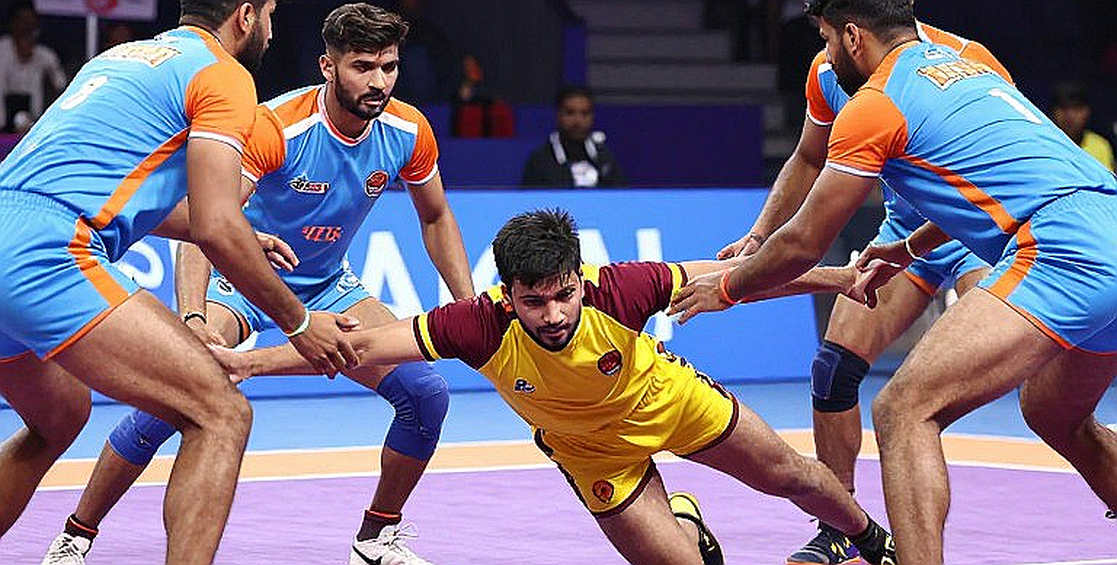
The second signal is the position of the third defender. A tackle looks like two men's work — one holds, one blocks. The key to the chain is the third man, who neither holds nor blocks. He closes the angle. If he arrives half a step late, the raider's toe lands, and one tap erases an entire defensive effort.
I have seen the pattern repeatedly: tackle success is high in the first ten minutes and falls in the last ten. Fatigue is only part of it. Late in matches, teams play with fewer men on the mat to avoid an all-out, and the third defender's role changes — he can no longer cover, because covering requires being there early. The raider finds the gap he did not have earlier.
There is a technical distinction the stands often miss. An ankle hold works when the raider's weight is forward; a thigh hold works when he begins to turn. The wrong hold at the wrong moment is the most common error — and it multiplies with fatigue, because a tired defender reaches before he thinks.
The third signal is the timeout, the least discussed and most informative. Each side gets two per half. The question is when. A team that calls one after conceding four straight points is fighting a fire; a team that calls one just before a do-or-die raid is taking a breath.
At Fatorda the silence was not empty; the stadium was holding its breath. I wrote that while covering the spectator-less Indian Super League in 2026, and learned that silence has a tempo. In kabaddi, the place where the breath is held is the timeout. Thirty seconds, eleven people gathered like four walls, a coach's board, a captain's voice. Outside, the stand is screaming. Inside, arithmetic.
In several matches I logged the raids immediately after timeouts. Teams that attacked the bonus line on the first raid after a timeout avoided do-or-die more often; teams that went deep instead settled for a point and were squeezed on the next raid. Not a rule — a tendency. And in a regular season, tendencies are the most valuable data.
The body sits underneath all of it. The thirty-second clock pressures defenders as much as raiders, because it shrinks their decision time. Mat surface, grip, ankle and knee load, a twenty-two-match travel schedule — these produce a team's real condition, which the scoreboard never shows.
My diary contains a small but repeated pattern: teams concede more in the second match of a home leg. The cause is not tactical but emotional and physical — the first match's intensity, family in the stands, then another game inside four days. Teams that rotate between those two matches lose less.
Which brings us to the third raider, the most neglected number of the regular season. For teams with two star raiders, matches are often decided by the third raider's share of raids. Opposing defences spend their planning on the stars; the third man is under-read, and the match turns in that neglect.
In matches decided by five points or fewer, the teams whose third raider took twenty-five per cent or more of the raids won most of them. The sample is small and the charting is mine, but the logic is clean: the regular season rewards depth, not stardom. Stars win playoffs, where matches are fewer and recovery is longer.
Now the outside reading starts to fail.
The popular version is simple: raiders win matches, defences win trophies. It is a comforting moral. But the regular-season table is set by revival order — which defender returns, and in what sequence. That sequence determines the shape of the defence on the next raid, whether the bonus line stays open, and where a raider can go under do-or-die pressure.
The second misreading concerns super tackles. A super tackle is drama: two points, a roaring stand. But it only exists when three or fewer defenders are on the mat — when the team is already in trouble. A side collecting super tackles regularly looks brave in the stats and fragile in structure.
The third is home advantage. We assume home means help. In a regular season it can invert, particularly in the second match of a home leg, when expectation and travel fatigue arrive together. Teams that manage their own emotion across those two games bank points at home; teams that cannot produce their worst performance in front of their own stand.
All three misreadings come from the same source: highlights. Highlights hold the raid, the tackle, the celebration. They do not hold the forty seconds after a tackle, when three defenders revive and the shape of the match changes. For a viewer who watches every game, those forty seconds are the game.
So when I sit down for the next match, I will watch three things. First, whether the team attacks the bonus line in its first two raids, and whether it counts the defenders before crossing. Second, where the third defender stands after the tenth minute of the second half — covering, or merely waiting to tackle. Third, the timing of the timeouts: who calls one after conceding four, who calls one before their own do-or-die.
The beat of a match lives in the people who wait for the whistle. The regular season is the season of waiting. In the playoffs everyone arrives at full strength, and structural cracks are easier to paper over. Across twenty-two matches, they show: a rotation, a late cover, a badly timed timeout, accumulating into a table.
Next time the stand begins counting — ten, nine, eight — will you watch only the raider, or also the third defender half a step behind him? Because the whole season is hidden in that half-step, and no highlights package will ever show it.
Related Players
Popular Reads
The Six-Foot Gap: Pawan Sehrawat's Leap, Kabaddi's Unseen Rhythm, and the Real Test of India's Title Defense2026-11-06
India Reach the Semi-Finals After Beating Bangladesh 48-25, but Defensive Questions Remain2026-11-05
The Quiet Stage in Ahmedabad: Olympic Dreams and Hardwood Realities at the Commonwealth Kabaddi Championship2026-11-05
Kabaddi Champions League Expands to Ten Teams, but a Haryana Regional Reality Lurks Behind the 'National' Label2026-11-03
India Crowned Double Champion: Commonwealth Kabaddi Championship 20262026-11-01
Recommended
Ten Teams, One State, One Vacuum: The Inside Arithmetic of the Kabaddi Champions League Expansion2026-11-03
The 62-35 Scoreline Hides Kabaddi's Real Story: Five Layers Inside Japan's Manga-Driven Rise2026-11-06
Commonwealth Kabaddi Championship 2026: 14-Nation Grid, India's Shadow, and the Tactical Lesson of Excluding Asian Games Gold Medalists2026-10-13
The Empty Cells in Kabaddi's Injury Ledger: The Missing Data Is the Biggest Injury2026-11-02
Inside the Bonus Line: The 'Hidden' Strategy Behind India's 42-21 Rout of Bangladesh2026-11-05
Recommended
India Reach the Semi-Finals After Beating Bangladesh 48-25, but Defensive Questions Remain2026-11-05
India Crowned Double Champion: Commonwealth Kabaddi Championship 20262026-11-01
Asian Games 2026: India beat Bangladesh 48-25 to seal semi-final spot2026-10-02
India's Kabaddi Before Iran: Asian Games 2026 Day Four, a Shaky Defence and an Unfinished Split2026-10-08
Asian Games 2026 Kabaddi: Bangladesh and Pakistan Top Groups After Day 12026-10-15
Recommended
The Half-Second Delay: Where Kabaddi's Defence Actually Breaks Mid-Season2026-10-31
Asian Games 2026 Kabaddi Semifinals: India's Unbeaten Arithmetic and the Gap of One All Out2026-09-26
Kabaddi: Thirty Seconds of Rule, and the Reality of a League2026-10-31
Autopsy of a 37–34 Final: Why Iran's Eight Bonus Points Could Not Stop India's Gold2026-09-26
Pawan Sehrawat Out of the Starting Seven: Risk and Information Gaps in the India vs Iran Final2026-10-01
Recommended
Not on the Terrace but in the Room: The Quiet Read of Kabaddi's Leadership Change at Asian Games 20262026-10-01
India's Kabaddi Before Iran: Asian Games 2026 Day Four, a Shaky Defence and an Unfinished Split2026-10-08
Autopsy of a 37–34 Final: Why Iran's Eight Bonus Points Could Not Stop India's Gold2026-09-26
The Six-Foot Gap: Pawan Sehrawat's Leap, Kabaddi's Unseen Rhythm, and the Real Test of India's Title Defense2026-11-06
Ten Teams, One State, One Vacuum: The Inside Arithmetic of the Kabaddi Champions League Expansion2026-11-03