
India Crowned Double Champion: Commonwealth Kabaddi Championship 2026
ভারত কমনওয়েলথ কাবাডি চ্যাম্পিয়নশিপ ২০২৬-এ পুরুষ ও নারী দুই বিভাগেই চ্যাম্পিয়ন হয়েছে। পুরুষ ফাইনালে ভারত শ্রীলঙ্কাকে ৫৪-২০ এবং নারী ফাইনালে উগান্ডাকে ৩৫-১৫ হারায়। ম্যাচগুলো প্রতিরক্ষা ও বারবার অল আউট দ্বারা নিয়ন্ত্রিত হয়েছে। ভারতের শক্তি ছিল দলগত গভীরতা: পুরুষ দলে আদিত্য শিন্দে সুপার ১০ করেন, ভারত হুডা ৮ রেইড পয়েন্ট নিয়ে একবারও ট্যাকল হননি, যোগেশ দহিয়া ৫ ট্যাকল পয়েন্ট নেন; নারী দলে সাক্ষী ৯, অনু সেন ৬ ও নিধি শর্মা ৫ পয়েন্ট করেন। তবে নারী ফাইনালের Statisticsে অসঙ্গতি আছে: ভারতের রেইড পয়েন্ট ১০ বলা হলেও তিন খেলোয়াড়ের যোগফলই ২০। এছাড়া, বাংলাদেশ ও দক্ষিণ কোরিয়া অনুপস্থিত ছিল, তাই শিরোনামটি ব্র্যান্ডিং হিসেবে গুরুত্বপূর্ণ হলেও ভারতের বৈশ্বিক আধিপত্যের প্রমাণ নয়।
India won both the men’s and women’s titles at the inaugural Commonwealth Kabaddi Championship 2026. The men’s team beat Sri Lanka 54-20, while the women’s team defeated Uganda 35-15. The event was held at a single venue in India, and the host team benefited from home conditions. The headline is accurate as stated, but its competitive weight depends on who took part and which rule set was used. This report combines the match facts, a kabaddi rules primer, player performances, tactical analysis, competition structure, regional context and data caveats.
Kabaddi is a South Asian contact sport. A raider enters the opponent’s half within 30 seconds, touches a defender and returns safely; defenders try to stop the raider in their own half. The raider must continuously chant ‘kabaddi’ to prove he or she is not inhaling; if the chant breaks, the raid is invalid. When an entire side is ruled out, the opponent gets 2 bonus points and the wiped-out team is fully revived. This all-out revival rule explains kabaddi’s famous swings. A raid scoring 3 or more points is a Super Raid; a tackle with 3 or fewer defenders on court is a Super Tackle and is worth 2 points; a raider scoring 10 or more raid points in a match records a Super 10. The bonus line gives 1 point when the defending side has 6 or more players on court.
The scoring structure here matches Standard Style kabaddi, not rural Circle Style. Both finals were driven by defense and repeated all-outs. India inflicted two all-outs in the women’s final and four in the men’s final. After each all-out, the opponent returned weaker, so the margin compounded. That is why the scorelines reached 35-15 and 54-20. These were not purely attacking showcases; they were defensive, error-driven blowouts against limited opposition.
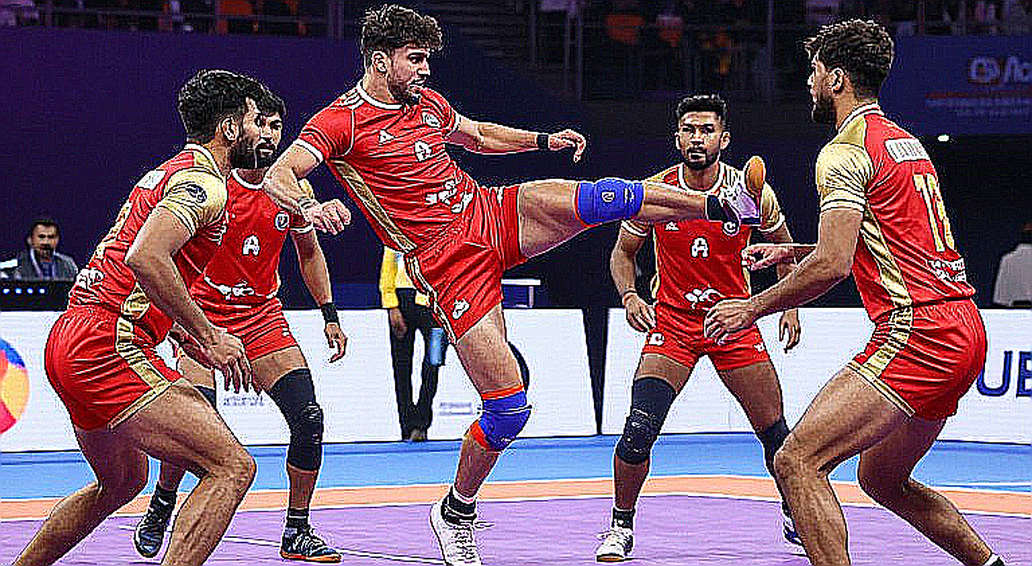
In the men’s final, Aditya Shinde scored a Super 10 with 10 points from 14 raids, roughly 71 percent raid productivity. Bharat Hooda scored 8 raid points and was not tackled once, the most striking efficiency indicator in the match. Yogesh Dahiya took 5 tackle points, and three other players added 2 each. India recorded 30 raid points and 14 tackle points. Four all-outs account for 8 points, giving 52; the remaining 2 points were plausibly bonus points. Sri Lanka’s 11 raid and 9 tackle points add up to 20. Apart from Maduwantha, no Sri Lankan player scored more than 5 points, showing a one-dimensional attack.
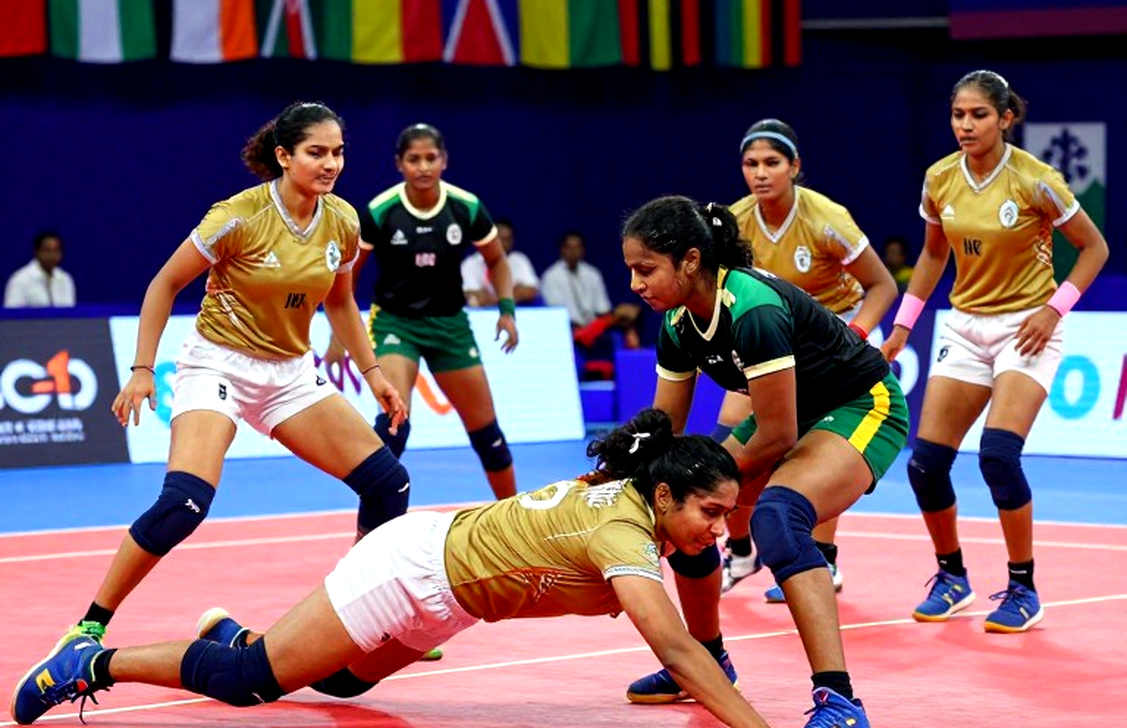
In the women’s final, Sakshi scored 9, Anu Sen 6 and captain Nidhi Sharma 5. Ritu Mitharwal and Suman Sahu took 4 tackle points each. India recorded two all-outs and led 20-14 in tackle points. But there is a serious data contradiction: the report says India’s raid points were only 10, while Sakshi, Anu Sen and Nidhi Sharma alone total 20. Both figures cannot be true if they are all raid points. Either the 10 is a typo, or the individual totals include tackle points. Uganda’s Nakayongo Shirat scored 11 of Uganda’s 15 points, yet Uganda recorded only 1 raid point, which suggests Shirat’s total was largely made up of tackle points. The women’s statistics therefore need verification before any strong dominance claim is made.
India’s main strength was depth, not one star. The men shared 30 raid points across multiple raiders, and the women’s three main scorers shared the load. Defense was also distributed. The opposition was limited: Sri Lanka relied heavily on Maduwantha, and Uganda’s output collapsed onto Shirat. Against such sides, India’s efficiency was bound to look inflated because the pressure level was low.
India’s real test was absent. Iran, Bangladesh and South Korea were not in this field. Because the event is built around Commonwealth membership, Iran cannot by design be present, so India’s strongest rival was structurally excluded. The report calls India the Asian champion, which confirms continental standing, but this event did not test that standing against the strongest Asian sides. The Commonwealth champion label is therefore a branding title, not a ranking statement.
Competitively, this was an inaugural international invitational with a heavily India-centric field. India was unbeaten in both genders, but that says less when the strongest challengers are absent. Sri Lanka and Uganda are Commonwealth members, and their participation is a genuine, low-base sign of internationalization in South Asia and Africa. Uganda reaching the women’s final and Sri Lanka reaching the men’s final are positive trend signals, but neither is yet a serious peer rival to India.
Culturally, kabaddi is tied to roughly 4,000 years of South Asian tradition and is often presented as a grassroots, mud-born sport, the opposite of cricket’s colonial colouring. Here it was repackaged inside Commonwealth branding. The Veer Savarkar Sports Complex venue and the host-team advantage fit a soft-power projection: India hosted, won and projected international reach with limited competitive risk. That is useful for domestic pride, but it risks overstating real global competitiveness.
Several caveats remain. The women’s raid and tackle breakdown is internally contradictory. The men’s figures almost reconcile but leave a 2-point residual unexplained. Do-or-die, bonus-line and timeout usage are not described, so the operational rule set of this new event cannot be fully confirmed. Finally, single-match statistics against weak opposition cannot support a claim of tactical invincibility. There is no evidence of how this Indian side would handle an Iran-style chain-tackle defense.
Overall, India is a deserved champion in this field. Both teams showed depth, collective defense and multi-option attacks. But the double-champion headline currently carries limited weight because of the event’s scope, absent rivals and data inconsistencies. Future participation by Iran, Bangladesh or South Korea, and the survival of a second edition, will show whether the title is more than branding.
Related Players
Popular Reads
The Six-Foot Gap: Pawan Sehrawat's Leap, Kabaddi's Unseen Rhythm, and the Real Test of India's Title Defense2026-11-06
India Reach the Semi-Finals After Beating Bangladesh 48-25, but Defensive Questions Remain2026-11-05
The Quiet Stage in Ahmedabad: Olympic Dreams and Hardwood Realities at the Commonwealth Kabaddi Championship2026-11-05
Kabaddi Champions League Expands to Ten Teams, but a Haryana Regional Reality Lurks Behind the 'National' Label2026-11-03
India Crowned Double Champion: Commonwealth Kabaddi Championship 20262026-11-01
Recommended
Asian Games 2026 Women's Kabaddi Final: Iran's Eight Bonus Points, India's Five-Point Raid Gap — What 37-34 Actually Says2026-09-26
Asian Games 2026: India's Kabaddi Schedule, Results, Timings & Live Streaming2026-10-18
Kabaddi: From a Game of the Soil to the Stage of Global Sports Economy2026-11-02
Commonwealth Kabaddi Championship 2026: What India's 17-Probables List and the 'Missing Stars' Question Actually Expose2026-10-08
Recommended
Amdavad 2026: The Question Nobody Is Asking Beneath the Logo2026-10-14
The Empty Cells in Kabaddi's Injury Ledger: The Missing Data Is the Biggest Injury2026-11-02
Fourteen Points Apart, Zero Raid Difference: The Column Nobody Read in Ahmedabad2026-10-25
When Mat Silence Writes History: India's Golden Double in Asian Games and Kabaddi's Hidden Crisis2026-10-07
India's 63-31 Win Over Korea: The Arithmetic Adds Up, the Match Sheet Doesn't2026-10-19
Recommended
Asian Games 2026 Kabaddi Semifinals: India's Unbeaten Arithmetic and the Gap of One All Out2026-09-26
Autopsy of a 37–34 Final: Why Iran's Eight Bonus Points Could Not Stop India's Gold2026-09-26
Pawan Sehrawat Left Out as India Name Fresh Faces for Commonwealth Kabaddi Championship2026-10-18
The Ledger of a Golden Double: India's Kabaddi Gold at the Asian Games, and the Numbers Nobody Prints2026-10-07
Recommended
The Empty Cells in Kabaddi's Injury Ledger: The Missing Data Is the Biggest Injury2026-11-02
Pawan in the Third Lane: A Six-Foot Leap, a 2.6 Crore Expectation, and the Name Missing from the Report2026-09-29
Asian Games 2026: Inside India's 37-21 Unbeaten Run — The Ledger That Must Be Opened Before the Semi-Final2026-09-28
Asian Games 2026 Kabaddi Semifinals: India's Unbeaten Arithmetic and the Gap of One All Out2026-09-26
The Ledger of a Golden Double: India's Kabaddi Gold at the Asian Games, and the Numbers Nobody Prints2026-10-07