
Kabaddi: Thirty Seconds of Rule, and the Reality of a League
কাবাড্ডি কী এবং কেন এটি গুরুত্বপূর্ণ? কাবাড্ডি সাত বনাম সাত খেলোয়াড়ের একটি আক্রমণ-প্রতিরক্ষা ক্রীড়া, যেখানে একজন রেইডার প্রতিপক্ষের অর্ধে ঢুকে ৩০ সেকেন্ডের মধ্যে ফিরে আসেন এবং পুরো সময় 'কাবাড্ডি' chant করতে বাধ্য হন। পয়েন্ট আসে স্পর্শ (১), বোনাস লাইন (১), ট্যাকল (১), সুপার ট্যাকল (২), সুপার রেইড (৩+) এবং অল আউট (২ বোনাস পয়েন্ট ও দল পুনরুজ্জীবিত) থেকে। টানা দুই খালি রেইডের পর ডু-অর-ডাই নিয়ম চালু হয়, ফলে অতিরিক্ত রক্ষণাত্মক খেলা অসম্ভব। দুটি সংস্করণ রয়েছে — স্ট্যান্ডার্ড স্টাইল (পিকেএল ও এশিয়ান Games) এবং সার্কেল স্টাইল (পাঞ্জাব, পাকিস্তান); দুটির Statistics তুলনাযোগ্য নয়। বাণিজ্যিকভাবে পিকেএল (২০১৪, আট থেকে বারো ফ্র্যাঞ্চাইজি) ক্রিকেটের বাইরে ভারতের সবচেয়ে সফল League, তবে একক সম্প্রচারকারী নির্ভরতা ও বিদেশি স্বত্বের কম মূল্য এর বড় ঝুঁকি। International স্তরে ভারত পুরুষদের স্ট্যান্ডার্ড স্টাইলে আধিপত্য ধরে রেখেছিল, যা ২০১৮ জাকার্তা এশিয়ান Gamesে ইরান ভাঙে। কাবাড্ডি অলিম্পিক ক্রীড়া নয়; Internationalীকরণের বাস্তব পথ এশিয়ান Games ও আঞ্চলিক বহু-ক্রীড়া ইভেন্ট।
Kabaddi's entire rulebook exists to answer one simple question: can a single person, alone, step into the territory of seven opponents and come back alive within thirty seconds? Raid, cant, tackle, bonus line, all out and do-or-die all grew out of that one question — that is the complete architecture of modern kabaddi.
To someone who has never watched it, kabaddi can look like a village-fair spectacle. In India's market reality, however, it carries a different identity: the only Indian sports property outside cricket that has held sustained prime-time television audiences. The Pro Kabaddi League (PKL) launched in 2026 with eight franchises; today there are twelve. That expansion is kabaddi's biggest story — and its biggest test.
The court is 13 metres by 10, seven players a side, two halves of 20 minutes. But inside those plain numbers sits an extraordinary machine.
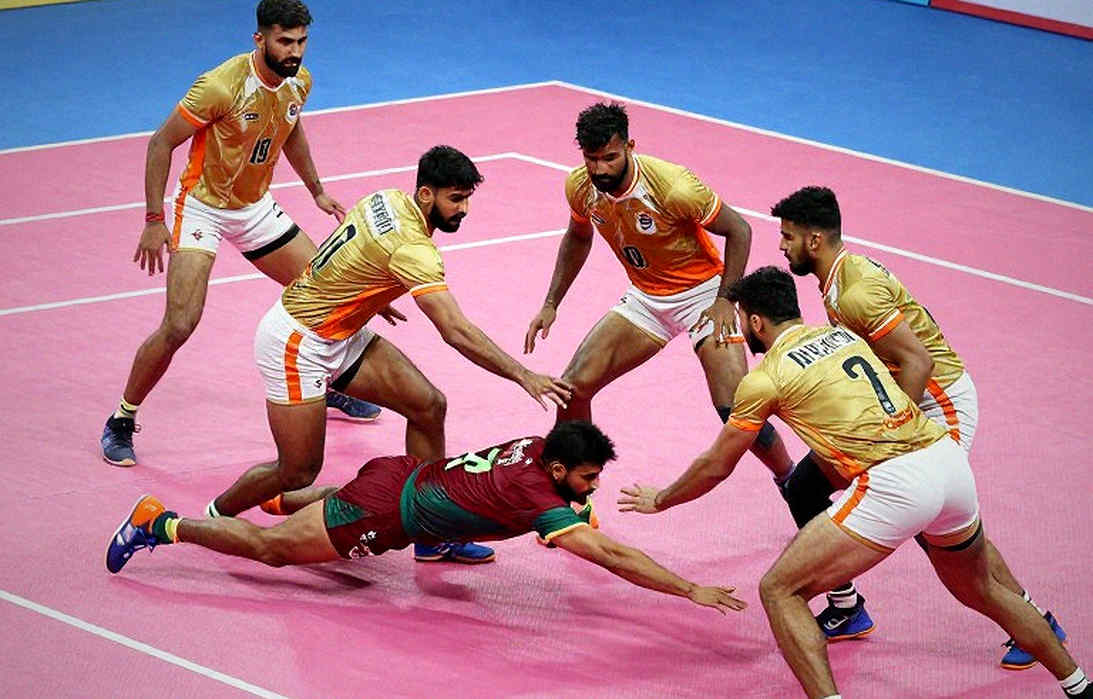
A raid is a solo invasion with a hard deadline. One raider crosses into the opponent's half and must return within 30 seconds. Touching one or more defenders and getting back safely scores a point. The condition is absolute: throughout the raid he must chant 'kabaddi-kabaddi' to prove he is not taking a breath. If the chant breaks, the raid dies on the spot. In plain terms, it is a breath-activated timer that the whole stadium can hear.
A tackle is the defence's only route to scoring. Seven defenders collectively stop the raider inside their own half — ankle hold, thigh hold, block, or a linked chain. A successful tackle is worth one point. The defence cannot simply sit passive; its only way to score is to physically contain the invader.
The bonus line is a marked line deep in the opponent's half. Crossing it while the defence has six or more players on court earns one point. It is, in effect, a courage allowance that pays the raider to go deep into danger rather than just touch and retreat.
All out is kabaddi's strangest structural feature. If a side loses all seven players to the out-box, the opponent gets two bonus points and the entire team revives. The scoreline therefore never moves linearly; the board can flip in a moment. Add the Super Tackle — a tackle completed with three or fewer defenders on court, worth two points — and the Super Raid, three or more points in a single raid.
Then there is Do-or-Die. After two consecutive empty raids, the third becomes do-or-die: fail again and the raider himself is out. The rule forcibly converts fear into self-destruction. A team cannot burn clock with empty raids and park a purely defensive game plan.
Together these rules produce a non-linear scoring model. Reading a kabaddi scoreline the way a football scoreline is read will systematically misjudge 'game control'. A six-point lead with ninety seconds left is not safe here. The bonus line, meanwhile, is the main driver of raider style differentiation — the deep-raiding bonus hunter versus the touch-and-return percentage raider. Without bonus-line data, a raider's true value is understated in raw raid points.
One warning is essential. Kabaddi has two distinct versions: Standard Style, played on a rectangular court, seven-a-side, used by the PKL and the Asian Games; and Circle Style, played on a circular field, one attacker against one defender, popular in rural Punjab tournaments and in Pakistan. Scoring details and match tempo differ materially, and media reports routinely fail to distinguish them. Likewise, 'Kabaddi World Cup' has historically referred to two different competitions — the International Kabaddi Federation's Standard Style World Cup and the Punjab government's Circle Style World Cup. Conflating them produces false signals about internationalisation.
On the competitive ladder the picture is relatively clear. In men's Standard Style, India long held a monopoly. Iran broke it at the Jakarta 2026 Asian Games, ending India's men's gold run and writing history. Below that sit Bangladesh, where kabaddi is the national sport with deep grassroots but a thin professional layer; South Korea, where systematic training plus PKL exposure is paying off; and Pakistan, where Circle Style is strongest and matches against India carry intense nationalist charge.
India's internal talent map is equally specific. Haryana carries a power-based defensive tradition; Maharashtra is a birthplace of modern standardised rules and systematised coaching; Punjab is the Circle Style heartland and the strongest cross-border cultural bridge; Uttar Pradesh and Tamil Nadu are known as raid-technique schools.
Behind that talent flow sits the akhada training system — mud-court, rural, low-cost, highly motivated. Added to it is the absorptive power of government jobs: railway, police, army. Honours such as the Arjuna Award reinforce the pathway. The 'kabaddi changed my family's fate' narrative is true, and individual cases are verifiable. But its use as a trend claim is frequently exaggerated. Without separating verifiable biography (village, district, government job, award) from editorial framing ('destiny', 'miracle', 'next legend'), the analysis stays weak.
The gender dimension is a structural gap. A women's game exists and has Asian Games status, but the PKL has no women's league. That is not a one-season issue; it is a pipeline risk.
Commercially, the PKL runs on an unusual model. Media rights sit largely with the Star/Disney Star network, and the league operator Mashal Sports is part of that same group — a vertically integrated arrangement. Alongside it are title sponsorship from domestic consumer brands and city-franchise ownership by Indian corporate groups and Bollywood figures.
Three vulnerabilities need testing. First, dependence on a single broadcaster. Second, near-zero overseas rights value, since the audience is essentially the South Asian diaspora. Third, ratings normalisation after the novelty peak. Together they narrow the league's revenue base.
The auction market is another test. Kabaddi auctions reliably generate a 'fame premium' for freshly crowned stars, and Indian media habitually presents the headline price as a proxy for quality. The correct test is to compare sale price against the last two seasons' efficiency output — successful raid percentage, do-or-die conversion, tackle success — not raw points totals. Price is a market-expectation signal, never a quality measure.
Governance is comparatively under-covered yet carries the largest downside. The Indian kabaddi federation has a documented history of election disputes and administrative turbulence, with periodic intervention by the Indian Olympic Association or the sports ministry. Anti-doping maturity sits below Olympic-mainstream sports; player registration and transfer systems are less mature than in cricket; retirement security is thin. The PKL has introduced televised review, but officiating consistency in international Standard Style remains uneven.
The Olympic pathway is closed. Kabaddi is not an Olympic sport and has not been shortlisted in recent cycles. The gaps are specific: the number of participating countries, continental coverage, and the depth of the women's game. The realistic route to internationalisation is regional and multi-sport-event based — Asian Games, Asian Indoor and Martial Arts Games — not Olympic inclusion.
A risk list opens with single-point dependence on a star raider, with concealed injury exposure attached. Then comes single-broadcaster dependence at league level, an auction salary bubble relative to commercial returns, federation turbulence that can block the national-team pathway, and nationalist-sentiment escalation around India-Pakistan fixtures.
At the narrative level, two stories demand the hardest testing. The first is the 'next Pardeep Narwal' succession story: the label is applied to almost any raider after one strong tournament, while the historical fulfilment rate is very low. The second is 'India conquers the world': Indian dominance in Standard Style is real, but the global participation base is very thin. Dominance and popularity are different claims.
At industry level, the PKL's real significance is as proof of concept — that a non-cricket Indian sport can be packaged into a commercially viable prime-time league through franchises, an auction, entertainment formatting and regional-language commentary. Badminton, wrestling, volleyball and table tennis leagues subsequently copied the template with mixed results. The most under-covered channel is the overseas-player route: Iranian, South Korean and Bangladeshi players in the PKL raise league quality while seeding the sport back home.
Finally, a methodological point. Four questions should be asked of any kabaddi report. One: is this Standard Style or Circle Style? Two: which body sanctioned it — international federation, national federation, league operator, or state government? Three: does the claim rest on volume points or efficiency statistics? Four: have verifiable facts been separated from editorial framing? With those four answers, the quality of a kabaddi report can be assessed; without them, it is narrative rather than analysis.
Kabaddi's future will therefore not be decided on the court alone. It will be decided in three places: diversification of broadcast rights, construction of a women's pipeline, and the stability of federation governance. The rules are already sound; the question is whether the institutions and the market can become worthy of them.

Related Players
Popular Reads
The Six-Foot Gap: Pawan Sehrawat's Leap, Kabaddi's Unseen Rhythm, and the Real Test of India's Title Defense2026-11-06
India Reach the Semi-Finals After Beating Bangladesh 48-25, but Defensive Questions Remain2026-11-05
The Quiet Stage in Ahmedabad: Olympic Dreams and Hardwood Realities at the Commonwealth Kabaddi Championship2026-11-05
Kabaddi Champions League Expands to Ten Teams, but a Haryana Regional Reality Lurks Behind the 'National' Label2026-11-03
India Crowned Double Champion: Commonwealth Kabaddi Championship 20262026-11-01
Recommended
Fourteen Points Apart, Zero Raid Difference: The Column Nobody Read in Ahmedabad2026-10-25
Commonwealth Kabaddi Championship 2026: The Hollow-Victory Risk Hidden Beneath the Logo2026-10-14
Asian Games 2026 Women's Kabaddi Final: Iran's Eight Bonus Points, India's Five-Point Raid Gap — What 37-34 Actually Says2026-09-26
Three All-Outs, Four Bonus Points and Six Missing Points: What I Found While Reconciling the India–Nepal Semifinal2026-09-26
Asian Games 2026 Kabaddi: Bangladesh and Pakistan Top Groups After Day 12026-10-15
Recommended
0.4 Seconds at the Raid Line: The Gap No Medal Table Records2026-10-30
The Empty Cells in Kabaddi's Injury Ledger: The Missing Data Is the Biggest Injury2026-11-02
Without Sehrawat: India's 17 Probables and Kabaddi's First Commonwealth Test in Ahmedabad2026-10-06
Amdavad 2026: The Question Nobody Is Asking Beneath the Logo2026-10-14
Not on the Terrace but in the Room: The Quiet Read of Kabaddi's Leadership Change at Asian Games 20262026-10-01
Recommended
The Real Score Was 31-17 at the Break, Not 48-24: What India's Win Over Nepal Left Untested2026-10-07
Where 54-20 Doesn't Add Up: What India's Commonwealth Kabaddi 'Double' Actually Proves2026-11-01
Without Sehrawat: India's 17 Probables and Kabaddi's First Commonwealth Test in Ahmedabad2026-10-06
India's Captaincy Announcement for the Commonwealth Kabaddi Championship: What Lies Beneath a Brief Statement2026-10-22
Pawan's Bench: The Star-Economy Test in the Asian Games Kabaddi Final2026-09-26
Recommended
Commonwealth Kabaddi Championship 2026: What India's 17-Probables List and the 'Missing Stars' Question Actually Expose2026-10-08
Commonwealth Kabaddi Championship 2026: Logo Unveiled, 14 Nations to Battle in Ahmedabad2026-10-14
Kabaddi: Thirty Seconds of Rule, and the Reality of a League2026-10-31
India's 63-31 Win Over Korea: The Arithmetic Adds Up, the Match Sheet Doesn't2026-10-19
The Half-Second Delay: Where Kabaddi's Defence Actually Breaks Mid-Season2026-10-31