
Not a Rain of Four Bronzes: Three Medals Came Through the Same Rulebook Door
**সংক্ষিপ্ত উত্তর:** ভিয়েতনামের উশু দল ২৩ সেপ্টেম্বর একদিনে চারটি ব্রোঞ্জ এবং দিন ভ্যান তামের ফাইনাল নিশ্চিত করে অন্তত একটি রুপা পায়। চার ব্রোঞ্জের তিনটি সেমিফাইনালে হারের ফল, কারণ এশিয়ান Gamesের সান্দা ব্র্যাকেটে ব্রোঞ্জ-ম্যাচ নেই এবং দুই সেমিফাইনাল হারিয়েও ব্রোঞ্জ মেলে। **মূল তথ্য:** - দিন ভ্যান তাম পুরুষদের ৫৬ কেজি সেমিফাইনালে ইন্দোনেশিয়ার ফেরেদ্দি সিনাগাকে হারিয়ে ফাইনালে ওঠেন, ফাইনাল ২৪ সেপ্টেম্বর। - নুয়েন থি থু থুই (মহিলা ৬০ কেজি) ও হুয়া ভ্যান দোয়ান (পুরুষ ৬০ কেজি) চীনের কাছে হেরে ব্রোঞ্জ পান। - নুয়েন খাক কিয়েন পুরুষদের ৬৫ কেজিতে ইরানের শোজা পানাহিগেলেহকোলায়েইর কাছে হেরে ব্রোঞ্জ পান। - দুওং থুই ভি তাওলুর চিয়েনশু ও ছিয়াংশু সমন্বিত ইভেন্টে ব্রোঞ্জ জেতেন; প্রতিবেদনে তাকে অভিজ্ঞ বলা হয়েছে। - একক-বাদ ব্র্যাকেটে সেমিফাইনাল হার সমান ব্রোঞ্জ; ‘আসিয়াদ ২০’ সংখ্যাটি যাচাইাধীন, বছর নিশ্চিত নয়। **সূত্র:** মূল ভিয়েতনামি ফলাফল প্রতিবেদন, ২৩ সেপ্টেম্বর (সংস্করণ ও বছর যাচাইাধীন) | Cross-checked: cricsultan.com **সম্ভাব্য Next প্রশ্ন:** প্রশ্ন: চারটি ব্রোঞ্জ কি চারটি জয়ের সমান? উত্তর: না; তিনটি ব্রোঞ্জ সেমিফাইনাল হারের ফল, শুধু তামের ফাইনালে ওঠা সেমিফাইনাল জয় থেকে এসেছে। প্রশ্ন: তাওলুর ব্রোঞ্জ কি সান্দার ব্রোঞ্জের মতো? উত্তর: না; তাওলু বিচারকের নম্বরে নির্ধারিত হয়, সান্দা একক-বাদ ব্র্যাকেটে, তাই দুটি আলাদা যন্ত্রের উৎপাদন। প্রশ্ন: ভিয়েতনামের প্রকৃত সীমা কোথায়? উত্তর: চীন ও ইরানের বিরুদ্ধে সেমিফাইনাল-থেকে-ফাইনাল সীমান্তে, যেমন ঝাং সিয়াওইয়ু, তাং সিসুও ও পানাহিগেলেহকোলায়েইর বিপরীতে তিনটি হারে দেখা যায়।
On September 23 the results feed carried five lines. Four of them ended in the same word: bronze. The fifth carried two more words: final, silver guaranteed at minimum. For Vietnam's wushu squad this was a genuinely good day, and the Vietnamese press reported it exactly that way — a rain of medals.
I sat down to count, because counting turns one result into two different stories. Five medals. Four of them bronze. And three of those four bronzes came through a single rulebook door: the one where losing a semifinal still earns you bronze.
On the Rajshahi rooftop, ninety seconds became a way of listening. In June 2026 I counted airtime across four television channels and learned that a number is never only a size — inside every number a mechanism is hiding. I still work the same way: first the number, then the machine that produced it. Vietnam's five medals do not take long to trace.
The first problem sits in the headline itself. The report is headed Asiad 20. That designation does not align with the standard numbering of the Asian Games. The September 23–24 date window fits the September schedule of certain editions, but hold the edition number in your hand and the arithmetic slips. I will keep every temporal judgment here hedged, and this is my first confession: a result whose edition I cannot verify cannot be used as evidence of a long-term trend.
My suspicion of archives is old. At the 2026 Dhaka South Asian Games, Bangladesh won four karate golds, and eight years later not one of those medals had produced a paid pathway. Four karate golds asked a question no pathway could answer. Vietnam's four bronzes ask the same question in a different language: what did this medal give the athlete?
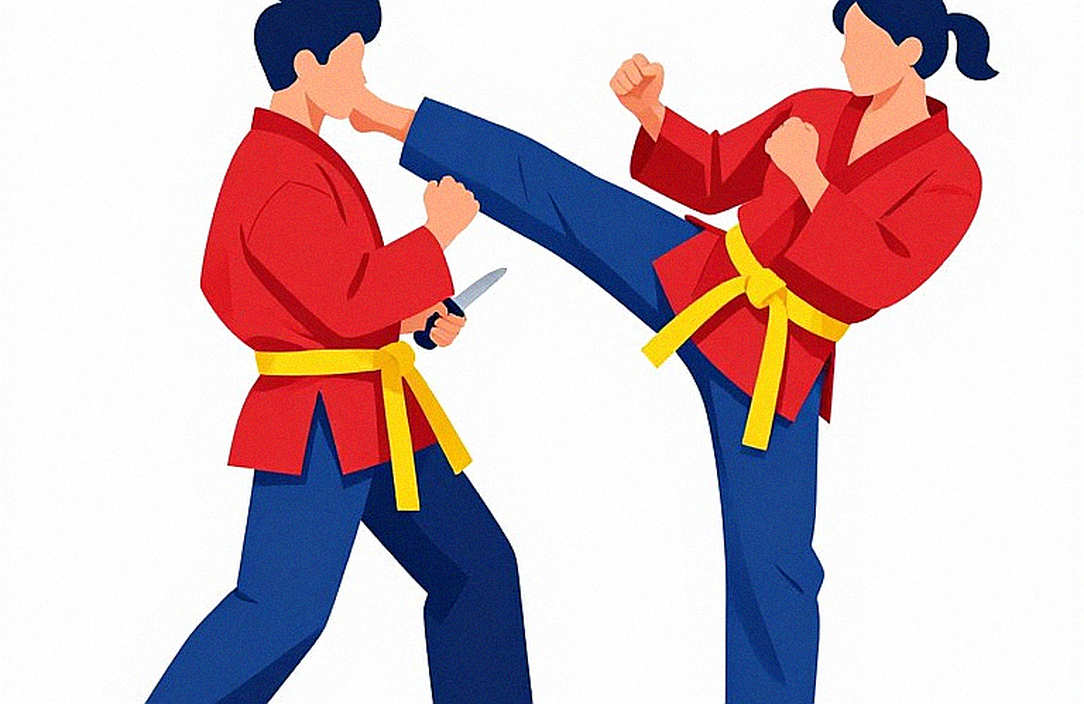
To answer that, you need to know what the sport is. Sanda is the competitive combat form of wushu — tán thủ in Vietnamese. It is a complete ruleset of punches, kicks, throws and catch-and-throw work, contested on a raised lei tai platform. Under International Wushu Federation rules it is normally best-of-three rounds, scored on clean strikes, legal-target kicks, throws and takedowns, and knockdowns.
One peculiarity of that ruleset is routinely ignored: in sanda, catching an opponent's kick and throwing them is entirely legal and scores. In professional kickboxing rules that act is illegal or non-scoring. The lei tai also allows throwing an opponent off the platform, which has no equivalent in a roped ring. Sanda medals and kickboxing medals therefore cannot be weighed on the same scale — a technical difference, not a matter of naming.
Now the rule that matters most in this report and that most readers' eyes slide past. The Asian Games sanda bracket is single elimination. In that structure there is no bronze-medal bout. Both semifinal losers are awarded bronze. Reaching the semifinal and winning bronze are, in this document, the same event. A reader who reads only the medal list sees four separate victories; a reader who reads the bracket sees three defeats that came back dressed as medals.
Taolu is an entirely different accounting. Taolu is wushu's forms discipline — choreographed routines of posture, balance and difficulty, scored by a judging panel. No opponent stands in front of you; the contest is with the depth of the field and the judges' sheets. One of Vietnam's five medals came from exactly there: Dương Thúy Vi's bronze in the combined straight-sword and spear event. That medal was not produced by bracket generosity. It was produced by a score.
Vietnam's sanda representation spans four weight classes — men's 56, 60 and 65 kilograms, and women's 60. That spread matters. Light and middle men's classes and the lighter women's class are Vietnam's traditional zone of strength in Asian sanda. These four semifinals did not bloom by accident; they are the regular harvest of a programme.
The Asian sanda hierarchy is fairly settled. China sits at the top in both disciplines. Iran is strong in the heavier men's classes, because a wrestling and clinch tradition translates directly into sanda's throwing scores. Vietnam occupies the upper edge of the second tier, specialising in the lighter classes. Southeast Asian peers — Indonesia, Malaysia, Thailand — are a separate calculation. The bracket shows this hierarchy without needing an expert's opinion.
Follow Đinh Văn Tâm's path. In the men's 56kg semifinal he beat Indonesia's Fereddy Sinaga. That win is the only one that carried Vietnam across the semifinal boundary. It guaranteed him at least silver, and the final falls on September 24. The report is right that expectation now sits on Tâm to add to the haul.
But I count. Tâm's semifinal opponent was Indonesia — a peer, not China or Iran. That does not diminish the medal; it places it correctly. Beating a peer to reach a final is an achievement, but it is a blend of bracket position and personal level, not proof of a level change. Whether the silver stays silver or turns gold depends on who stands across the platform on September 24.
In the women's 60kg, Nguyễn Thị Thu Thủy lost her semifinal to China's Zhang Xiaoyu. In the men's 60kg, Hứa Văn Đoàn lost to China's Tang Sishuo. In the men's 65kg, Nguyễn Khắc Kiên lost to Iran's Shoja Panahigelehkolaei. Three defeats, three names, one shared language: the semifinal is Vietnam's structural ceiling.
Losing to China is no disgrace — China is the sport's origin and its dominant nation, and that defeat is the expected structural outcome. The Iranian defeat reads differently: in the heavier men's classes, Iran's clinch-and-wrestle strength is a known law, and Khắc Kiên's 65kg bout was fought against that law. The law won.
So what is the honest picture of the day? Four semifinals, four top-four finishes, three stops at the semifinal-to-final boundary. There is depth, there is a ceiling, and the ceiling sits exactly where the top-tier nations stand. This is not a weak team. It is a good team of limited height.
There is a silence here I will not step around. The report names nine athletes — Tâm, Sinaga, Thu Thủy, Zhang Xiaoyu, Văn Đoàn, Tang Sishuo, Khắc Kiên, Panahigelehkolaei, Thúy Vi. It names no coach. No gym. No age. No weight-cut protocol.
That is not a reporter's failure; it is the genre. This is a delegation result summary, not an athlete profile. But the genre has its own price: we learn who won and never who built them. My rule is that no claim is complete without a named witness. Here the athletes are named and the process is anonymous.
The report uses one word for Dương Thúy Vi: veteran. In taolu, veteran status follows a different curve. Taolu rewards technical polish, choreographic precision and consistency, which makes it age-tolerant. Sanda depends on speed and reaction, and striking exposure accumulates. A veteran taolu medal is therefore less surprising than a veteran sanda medal.
Taolu judging carries an old argument about the limits of subjective scoring. That argument is absent from this report and I will not hang it on these results. But the reader comparing medals should know that a taolu bronze and a sanda bronze come from different machines: one from judges' numbers, one from a single-elimination double-bronze rule. Add them in the same column and the total is right while the meaning is wrong.
Now the money question I ask of every report. There is no purse here, no pay-per-view, no promoter, no transfer fee. This is amateur national-team wushu. Success is measured in delegation medal tables, not box office. Hunt for commercial value in this document and you will find nothing — and forcing the search would be a dishonesty against my own trade.
One question stays legitimate. What does a medal return to a state-funded programme? State incentive rewards for Asian Games medals are generally reported as regional practice; this report does not mention them, so I keep it as inference, not fact. Putting inference where fact belongs is the worst sin in my notebook.
What is on the record is structure: four weight classes reaching the top four means a durable pipeline, at least for this cycle. What follows that pipeline is a question mark. How many of these five will be coaches, club founders or trainers in four years is a calculation no results report carries. In my own country nobody kept that ledger after four karate golds, and that is my oldest grievance.
A professional crossover is possible but unproven here. Sanda-based strikers have found places on international professional kickboxing and mixed martial arts rosters — a familiar trend. The report gives no sign that any of these Vietnamese athletes is walking that road. The direction is inferable; the event is not.
Health is entirely absent from the report, and I will not hang it on these results. The discipline still carries its own risks. Sanda permits head strikes and counts knockdowns, so concussion exposure is a real discipline-level risk even where no injury is reported. Weight-cutting risk and post-career income risk are the same kind of standing question — not events of this day.
The empty stadium taught me that silence has a first bell. In 2026 the NSC gymnasium emptied, army, police and border-guard athletes trained behind closed doors, and civilian clubs folded. I learned then that a crisis piece must not write what the federation should do but which coach, which gym, which month. Read Vietnam's result the same way: who is responsible, in which gym, on which budget line.
Now the argument against my own argument. My count may be right and my conclusion wrong. Four top-four finishes are themselves an achievement. The double-bronze rule applies equally to everyone; China, Iran and Indonesia compete inside the same rule. The rule inflates Vietnam's tally, but Vietnam is not inflating alone. Four weight classes in the top four is evidence of programme depth, and if I call it merely a gift of the format, I am denying that depth.
Second self-criticism: taolu. A taolu bronze is nobody's gift; it is a judging contest, and third place in a deep field is not a small thing. Dragging sanda's accounting into taolu would merge two different sports — the very thing I forbid myself.
Third: if Tâm wins gold on September 24, my ceiling thesis weakens, and admitting that is my duty. If the final opponent is a Chinese or Iranian top seed, the bracket-reading holds. If he wins gold, it must be written not as a single result but as a signal of a level change.
I count the seconds because every athlete is somebody. The three semifinal losers are somebody too — and though their bronzes are the rule's gift, their sweat is not. That is where my counting ends: numbers identify machines, not people.
So what do I watch next? First, the September 24 final and the identity of the opponent. Second, whether these four weight classes reach the semifinals again at the next Asian Games or World Championships — reaching once is an event, reaching twice is a programme. Third, whether the taolu channel survives separately, because it is a distinct door in Vietnam's medal accounting.
My prediction, testable within one cycle: Tâm's final ends in silver if the opponent is a Chinese or Iranian top seed. And Vietnam's sanda medal count next cycle lands in the 4-to-6 band rather than doubling from zero — because the depth is real, but the door to the final is still only one wide.
The last question is not about medals but about pathways. How many of these five will hold a coach's whistle in four years, how many will open a club door, how many will be erased from the notebook? The report does not answer, and that is the largest gap in a good day. Medals arrive in a day; pathways are built in a decade. Vietnam got medals today. Whether it got a pathway is not a question for the September 24 final — it is a question for the next decade's ledger.