
Jangoo's T20I Call-Up: The Numerical Gap Hidden Inside ODI Form
**মূল উত্তর:** আমির জাঙ্গু ২০২৪ সালের ডিসেম্বরে অভিষেকের পর সাতটি টি-টোয়েন্টিতে ১৬৩ রান করেছেন, স্ট্রাইক রেট ১২০.৭৪। ভারত সফরে ওয়েস্ট ইন্ডিজের তিন ম্যাচের ওয়ানডে সিরিজে ২৩৯ রান (৫৮*, ১১৪, ৬৭) করার পর তাঁকে আহত কিপার জুয়েল অ্যান্ড্রুর কভার হিসেবে টি-টোয়েন্টি দলে ডাকা হয়েছে। **মূল তথ্য:** - আমির জাঙ্গু ২৯ বছর বয়সী উইকেটকিপার-ব্যাটার, International অভিষেক ডিসেম্বর ২০২৪। - ওয়ানডে সিরিজে ২৩৯ রান, দুই দলের মধ্যে তৃতীয় সর্বোচ্চ, শুধু শুভমান গিল ও শাই হোপের পিছনে। - টি-টোয়েন্টি রেকর্ড: ৭ ম্যাচ, ১৬৩ রান, স্ট্রাইক রেট ১২০.৭৪ — আধুনিক মানদণ্ডের নিচে। - ডাকটি কভার হিসেবে শর্তসাপেক্ষ; জুয়েল অ্যান্ড্রুর আঙুলের এক্স-রে পরিষ্কার, কিন্তু তিনি এখনো পর্যবেক্ষণে। - পাঁচ ম্যাচের টি-টোয়েন্টি সিরিজ ভারতের মাটিতে — লখনউ, রাঁচি, ইন্দোর, হায়দরাবাদ, বেঙ্গালুরু। **সূত্র:** The Express Tribune, "Jangoo gets T20I call-up after stunning ODI run" | Cross-checked: cricsultan.com **সম্পর্কিত প্রশ্নোত্তর:** প্রশ্ন: জাঙ্গুর টি-টোয়েন্টি স্ট্রাইক রেট কি উদ্বেগের কারণ? উত্তর: ১২০.৭৪ আধুনিক টপ-অর্ডার মানদণ্ডের (১৩০–১৪৫) নিচে, তবে সাত ম্যাচের নমুনা ছোট। (cricsultan.com Player Depth Index) প্রশ্ন: জাঙ্গু প্রথম একাদশে খেলবেন কি? উত্তর: নির্ভর করে জুয়েল অ্যান্ড্রুর ফিটনেসের উপর; সুস্থ হলে জাঙ্গু বেঞ্চে থাকতে পারেন। প্রশ্ন: ওয়ানডে Form কি টি-টোয়েন্টিতে অনুবাদ হবে? উত্তর: দুটি ভিন্ন Format ভিন্ন মেট্রিক দাবি করে; ওয়ানডে রান টি-টোয়েন্টি মূল্যের নিশ্চয়তা নয়।
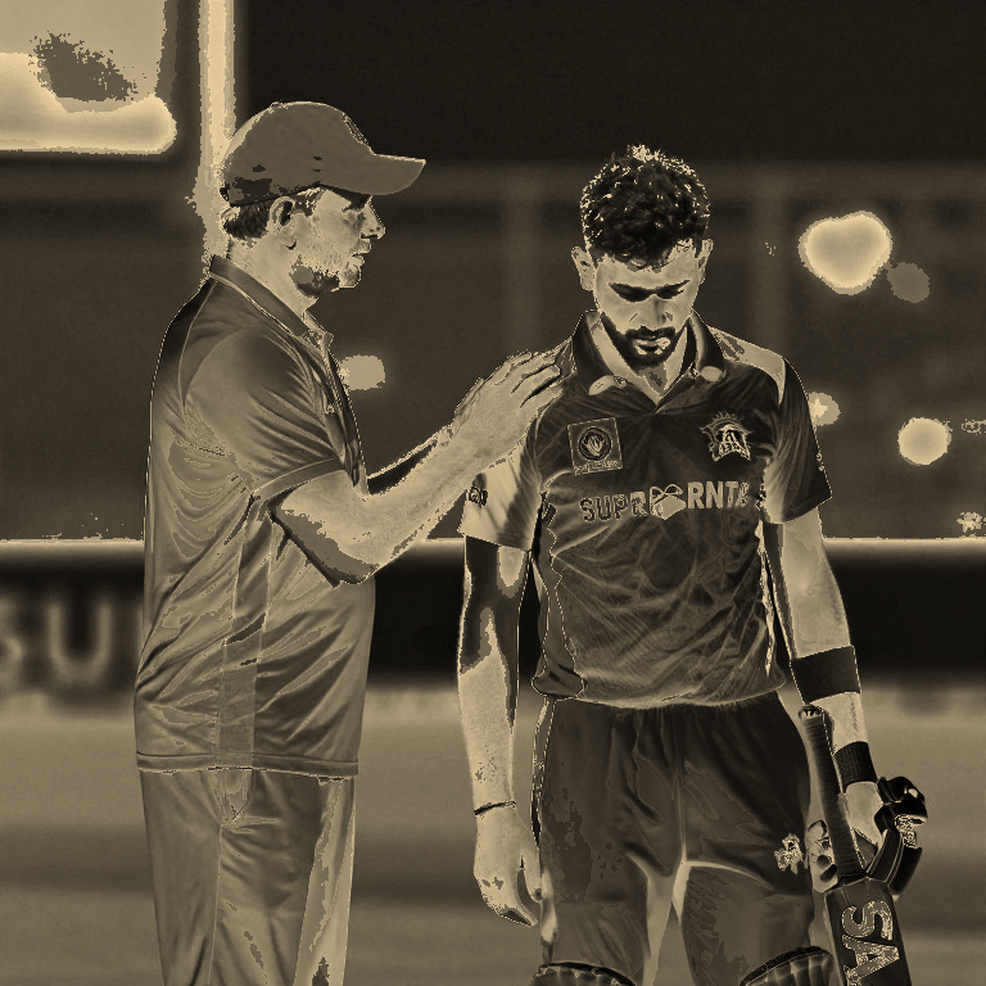
239 runs. Three innings. 58*, 114, 67. That is the entire ledger of Amir Jangoo's just-completed ODI series. On West Indies' tour of India, this wicket-keeper batter's name now sits in the T20I squad, because of a finger injury to Jewel Andrew. The headline reads "stunning ODI run." But when I opened the hand-coded season again, one number was sitting quietly in the column: 120.74.
That is his T20I strike rate — seven matches, 163 runs. In the very format he has been called up for, that figure sits below the modern benchmark. Two numbers, 239 and 120.74, describe the same man, but in two different formats. And when the format changes, the yardstick changes. This is where the story's real tension lives.
This September-October tour splits into two parts. First a three-match ODI series, now complete. Then a five-match T20I series about to begin — Lucknow, Ranchi, Indore, Hyderabad, Bengaluru. Two formats, two different measures. ODI rewards the patience to build an innings, average, and balls consumed. T20I rewards strike rate, boundaries, the appetite for risk. Success in one is no guarantee in the other — I reconcile these columns by hand every series.
My method is simple but demands patience. Before translating one format's performance into another, I separate two things: what the player did, and what the format demands. Fifty overs in ODI means there is time — you can spend balls, build an innings. One hundred and twenty balls in T20I means each delivery costs more, you must take risks, and strike rate is the primary currency. Line up the runs from two formats without reconciling this difference and the numbers do not lie, but they do not explain either.
At New Chandigarh, in Mullanpur, the match produced a record successful chase. That single fact tells you what the ODI surfaces were like — batting-friendly, with true bounce. Scoring 239 on such a deck is genuinely good, but the readability of those runs is open to question. The same 239 on a seaming track would carry far more weight. I always keep that distinction separate, because runs are never neutral without their environment.
Jangoo's ODI series was consistent — not a single-innings flash. Three contributions across three matches, third-highest run-scorer across both teams, behind only Shubman Gill and Shai Hope. That consistency is the strongest part of the "form" case. A single 114 and a series total of 239 differ by little in number but a great deal in meaning. I reconcile the columns by hand before I call anything a trend, and here three separate contributions form a dependable pattern.
But the T20I ledger is different. Since his international debut in December 2026, Jangoo has played seven T20Is for 163 runs at a strike rate of 120.74. In modern T20I, the expected strike rate for a top-order or middle-order batter is 130 to 145; finishers sit above 150. For a wicket-keeper batter, the expectation is no lower, and this figure sits beneath it. Seven matches is a small sample, so the error bars are wide — this is a caution flag, not a verdict. Still, the number stands, and I do not wave away a standing number.
This is the central contradiction. The story promotes Jangoo on ODI form, yet his existing T20I record is below par. The same name, two formats, two different cricketers. When I change format, I change metric — an old habit of mine, going back to 2026, when I hand-tagged all 588 shots, 197 on target, across Chattogram Abahani's 22 matches.
Beside this sits one more fact: age 29, debut December 2026. He is not a young prospect but a late-blooming, experienced domestic performer. At this age, "development upside" is limited, but short-term reliability is higher. The "stunning form" framing obscures that nuance. On the age curve he is near the peak, not past it — that is the accurate reading.
And where does his real selection value lie? In the keeping. The call-up is explicitly as cover for an injured keeper — Jewel Andrew's finger injury. His primary duty is the gloves; batting is the secondary argument. Andrew's X-ray is clear, no fracture, but he remains under observation, not yet ruled out of the squad. Jangoo's place is therefore conditional.
One question matters here, and the headline never asks it: how fragile is West Indies' keeper depth? An injury to one keeper forcing a mid-tour call-up from outside is a structural signal. Elite sides usually carry redundant keeper cover. That extra layer is absent here, and that gap is what turns a squad-news item into something worth tracking.
I keep a baseline every series. What the average strike rate of wicket-keeper batters in T20I has been over recent years sits in my book. Set Jangoo's 120.74 against that baseline and the gap is plain. Without a baseline, a number says nothing on its own — whether 120.74 is good or bad is decided by the comparison, not the figure.
From personal experience: in 2026, when the game stopped, I spent fourteen months re-coding 462 matches from four previous seasons. That silence taught me that stillness is itself a dataset; an empty row is never a zero. Here too — the facts the article does not give (the series result, the nature of the pitches, the timeline of Andrew's injury) are missing rows. I do not treat them as zeros; I flag them separately.
The second dimension is the long five-match series. On Indian soil, across five venues, against the home side India, led by Shubman Gill. This is one of the toughest assignments in T20I. Five matches means not just a first XI but squad depth is decisive. That is precisely why a cover call-up is plausible even without a first-choice vacancy. Jangoo's opportunity is born of a structural gap, not a personal flash.
One more venue consideration. Five venues means five kinds of pitch — some batting-friendly, some spin-assisting, and the risk of October evening dew. For a keeper, dew means extra work: a wet ball, harder to judge the pitch. Over a long series, that workload raises the rotation question. This physical context is absent from the headline but will be present in the series' trajectory.
Now the counter-argument. In the media's language — "stunning," "sparkling," "spectacular" — the adjectives describe ODI form, not any T20I-relevant metric. This is a classic pattern: framing runs ahead of format-specific data. Assuming a link between the two formats is the biggest analytical trap. Inferring T20I value from ODI runs is a confusion I call cross-format contamination. Correlation is not causation; playing both formats on one tour does not make the two skill sets interchangeable.
One more subtlety: the call-up is as "cover," conditional by design. If Andrew recovers, Jangoo's role may be minimal; if he does not, Jangoo could abruptly become first choice. His squad status is provisional by design. The ledger is patient; the market is not — but this call-up's shelf life is impatient too.
The overall risk rating is low to medium. No commercial, governance, or integrity risk is present. The elevated element is performance risk — the gap between ODI form and existing T20I output. The second risk is Andrew's injury management. The third is the small sample — three ODI innings, seven T20Is; neither is enough for a durable conclusion.
The public narrative is telling. The "rising star, late bloomer" frame is now in its germination-to-acceleration phase. But that narrative rests on adjectives, not on T20I-relevant numbers. Its lifespan is therefore short-term — the moment Andrew is declared fit, the expiration trigger is pulled.
One dimension cannot be left out, though it is absent from the report: a strong series by a 29-year-old wicket-keeper batter could raise his IPL auction visibility in the next cycle, since keeper-batters are a scarce and premium auction category. But the report does not mention the IPL, so this is only a directional inference, not a conclusion. An empty row is not a zero — and just as surely, absent information is not a basis for imagination.
So what do I watch going forward? First, Andrew's fitness. Declared fit, Jangoo sits on the bench; slow to recover, Jangoo plays. That single fact will decide his entire series. Second, the trajectory of Jangoo's T20I strike rate. If it climbs toward 130 across five matches, the ODI-form transfer is proven. If it stalls near 120, the doubt remains. Third, his batting position. Top-order or finisher, or keeper only — the expected benchmark changes when the position changes. Fourth, the nature of the pitches. Batting-friendly or spin-assisting — the readability of any batting output depends on this.
One last word. I do not believe in fate; I believe in data. Jangoo's ODI series was genuinely good — 239 runs, consistent, third across both teams. There is nothing to deny in that success. But T20I certainty cannot be drawn from it, especially when the existing T20I strike rate is 120.74. The question is simple: do we judge him as an ODI batter, or by the T20I yardstick? Two answers, two futures. The field will give the verdict — and my ledger will record it, ball by ball.
Related Players
Popular Reads
Lucknow's Dew Debt: Iyer-Kishan's 137 and the Unfinished Ledger of a Caribbean Collapse2026-10-07
After Harmanpreet, Mandhana: The Hidden Arithmetic of India Women's Leadership Change2026-10-07
Cricket's New Innings: Blockchain Enters the Deal Ledger2026-10-07
The Night of the Empty File: Cricket Analysis's Silent Crisis2026-10-06
The Document of Empty Pages: When Cricket Analysis Itself Faces an Existential Crisis2026-10-06
Recommended
The Ledger and the Field: The Gap Between Price and Value in Cricket's Transfer Market2026-10-02
From Khulna's Ledger to an On-Chain One: Cricket's Data Integrity and the Quiet Failure of Blockchain2026-10-05
Beyond the Boundary Line: ICC Fielding Regulations, Dhaka's 'Missing' Grass, and the Quiet Truth of the Run-Out Controversy2026-09-30
The Document of Empty Pages: When Cricket Analysis Itself Faces an Existential Crisis2026-10-06
That Rawalpindi Dawn: The Test Win That Was Paid For in Dhaka's Bedrooms2026-10-02
Recommended
After Harmanpreet, Mandhana: The Hidden Arithmetic of India Women's Leadership Change2026-10-07
The Quiet Door of the Casual Contract: Where Bracewell's Decision Takes New Zealand Cricket2026-10-06
Cricket on the Chain: Fan Tokens, NFTs, and the Door That Closes Itself2026-10-01
Blockchain and Cricket: The Ledger Beyond the Pitch That No One Can Erase2026-10-03
The First-Ball Ledger: Why a Series Opener Is Cricket's Biggest Drama and Its Thinnest Evidence2026-10-04
Recommended
Mumbai's Vice-Captain Mhatre, Suryakumar Left Out: Red Ball and White Ball Keep Separate Ledgers2026-10-06
The Anchor's Erasure: 3:47 a.m. in Sydney, and the Batting Grammar Bangladesh Is Losing2026-10-02
NOC, Retention and the Auction Purse: Who Really Sets the Price in Franchise Cricket2026-10-02
One Wicket Every 21 Balls: What Khulna's Second-Innings Spin Spike Is Actually Saying2026-09-26
Cricket's Ledger Is Not Immutable: DRS Logs, DLS and the Trust Arithmetic of Blockchain2026-10-05
Recommended
From Fan Tokens to Smart Contracts: How Real Is Cricket's Blockchain Backbone?2026-10-03
The Empty Block: Evidence-Chain Integrity and the Risk of False Confidence in Cricket Analysis2026-10-05
Scorchers land Pakistan captain in Big Bash coup2026-10-04
Standing at Both Ends of the Apartheid Ban: 49 Tests, 17 Captains, and the Quiet Rivalry Between Australia and South Africa2026-10-06
An Under-19 Dossier Inside the Transfer Window Noise: From the 2026 Trophy to the Senior Minutes Ledger2026-09-26