
HomeAthleticsAsian Games 2026 Day 6: Four Athletics Medals for India, a First-Ever Pole Vault History
Asian Games 2026 Day 6: Four Athletics Medals for India, a First-Ever Pole Vault History
এশিয়ান Games ২০২৬-এর ষষ্ঠ দিনে ভারত অ্যাথলেটিক্সে চারটি পদক জিতেছে: গুলভীর সিং (পুরুষদের ১০,০০০ মিটার রুপা), বারানিকা এলাঙ্গোভান (মহিলাদের পোল ভল্ট ব্রোঞ্জ, ৪.১৫ মিটার — ভারতের প্রথম এশিয়ান Games পোল ভল্ট পদক), মনপ্রীত কৌর (মহিলাদের শট পুট ব্রোঞ্জ, ১৭.১৭ মিটার) এবং বিষাল থেন্নারাসু (পুরুষদের ৪০০ মিটার হিট জয়)। মিক্সড ৪×৪০০ মিটার রিলেতেও ভারত রুপা জিতেছে। ষষ্ঠ দিন শেষে ভারতের পদকসংখ্যা ২২, Position দ্বাদশ। তবে প্রতিবেদনে কোনো দৌড়ের সময়, স্প্লিট বা বাতাসের তথ্য নেই, ফলে ফলাফলগুলোর প্রকৃত প্রতিযোগিতামূলক মান নির্ভুলভাবে নির্ধারণ করা সম্ভব নয়। বাহরাইনের দুই ধাবক ১০,০০০ মিটারে গুলভীরের বিরুদ্ধে কৌশলগতভাবে দৌড়েছেন, যা দলগত গভীরতার ইঙ্গিত দেয়। ২০২২ সালের ২৮ স্বর্ণের মানদণ্ডেই ভারতের সামগ্রিক সাফল্য বিচার করা উচিত।
India's athletics contingent returned from Day 6 of the 2026 Asian Games in Aichi-Nagoya with four medals: Gulveer Singh's silver in the men's 10,000m, Baranica Elangovan's historic bronze in the women's pole vault, Manpreet Kaur's bronze in the women's shot put, and Vishal Thennarasu's heat win in the men's 400m. Taken together, it was unmistakably a day of breadth for Indian athletics rather than a day of continental dominance; none of the four results signalled an athlete on the verge of becoming Asia's No. 1.
The most discussed result is Gulveer Singh's. He took silver in the men's 10,000m final and, according to the report, ran the closing 400m extremely well. But the true quality of that silver cannot be established, because his time is not reported anywhere — no time, no splits, no wind readings. That data gap is the single largest analytical hole. Some inference is still possible from the shape of the race. Two Bahraini runners worked tactically against Gulveer, effectively closing him down as a team. In that context, a strong final 400m means this was not a time-trial but a tactical, championship-style race decided by a final-lap kick. Gulveer won the tactical battle rather than losing the clock. As a championship racer, that is a positive signal, though his winning time was probably somewhere in the 28:00–29:00 band.
There is, however, a major physiological risk in his case. He appears to have peaked twice in one season: silver at the Commonwealth Games in Glasgow in July, then silver at the Asian Games in September–October. Two championship peaks within about eight weeks sits at the very edge of accepted periodisation practice in endurance sport; the second peak usually costs either the first or the second. Gulveer secured both, which is evidence of his capacity and of centralised planning — but it is a controlled gamble, not a routine outcome. The report frames him as 'an inspiration to the entire Indian contingent,' and that framing is backed by result substance, not narrative alone.
Vishal Thennarasu's heat win in the 400m is another noteworthy result. The report says he accelerated in the last 50m to win his heat. That is a positive shape indicator, but a heat win carries limited standalone diagnostic value, because heat-to-final conversion in the 400m is notoriously unreliable. On top of that, his load is elevated — he won silver in the mixed 4×400m relay on Thursday, then ran the individual 400m heats, and now carries the pressure of advancing to the final. Running relay legs and individual rounds on consecutive days accumulates high neuromuscular fatigue; the risk surfaces in the final, not the heat. His heat was probably run conservatively for the first 300m, with the late surge being a qualifying-control move rather than an all-out effort.
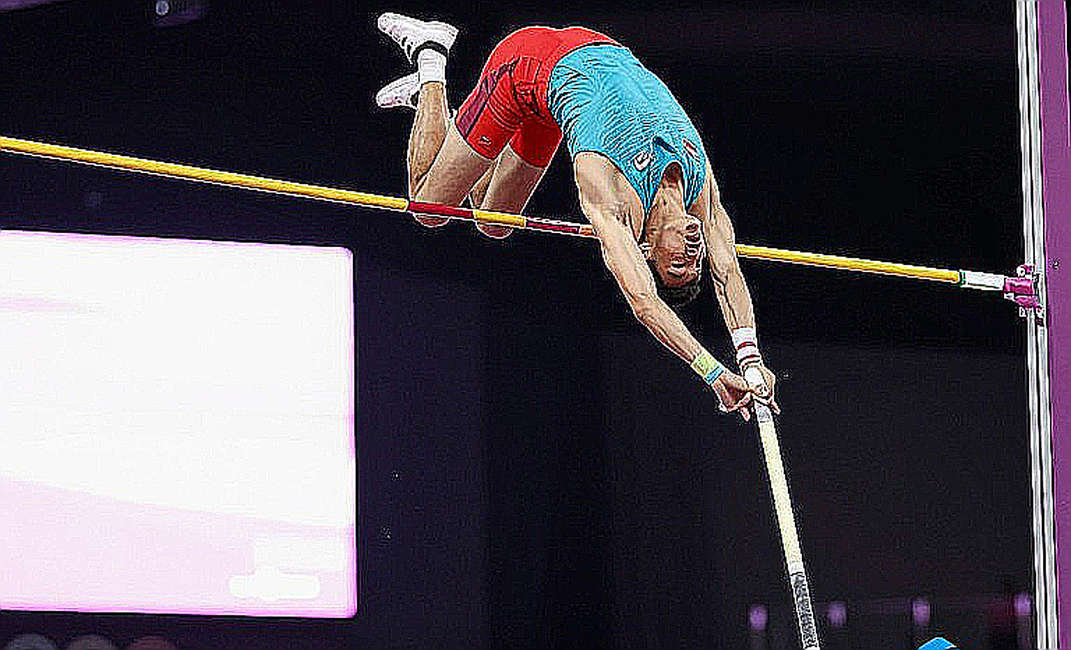
Baranica Elangovan's 4.15m bronze in the women's pole vault is a genuine milestone — it is India's first-ever Asian Games pole vault medal. But judged on absolute standard, it sits well short of world level. The world record is 5.06m and the Paris Olympic entry standard is 4.73m, meaning her performance is roughly 0.91m below the world record and 0.58m below the entry standard. China has historically led Asian pole vault; a 4.15m bronze strongly suggests the leading powers were either absent or off-form. In other words, this result carries national-precedent value rather than competitive value. The 'historic' storyline around this Tamil Nadu athlete will travel fast, but the reality is that the mark itself will invite questions about improvement. The winning height was probably in the 4.30–4.50m range, well below the 2026 Hangzhou standard.
Manpreet Kaur's 17.17m bronze in the shot put follows the same pattern. The world record is 22.63m and the Paris Olympic entry standard is 18.80m, so the mark is about 1.63m short of a global standard. That is plausible at Asian continental level but modest by world standards. The result says more about the depth of the Asian women's shot put field than about Manpreet's ceiling. A caution is warranted: multiple Indian athletes share the name 'Manpreet Kaur,' the report does not disambiguate, and the data should be treated as pending verification.
Overall, India sits 12th with 22 medals after Day 6. But that mid-Games position is structurally misleading, because medal-rich sports are scheduled unevenly across the Games. The correct comparison is with the 2026 Asian Games, where India won 28 gold — not with the Day-6 table. On the day, India also won its first shooting gold and historic medals in air pistol; those results sit outside athletics but complete the picture of India's medal profile.
The strongest structural signal of the day, however, is the mixed 4×400m relay silver. A relay medal requires four athletes operating at a coordinated standard, a baton-exchange process, and coaching continuity — far harder to produce by accident than a single bronze. India's 400m and relay development looks structurally healthy. Both Vishal and Baranica are from Tamil Nadu, a regional clustering that is a soft signal of a functioning state-level development pathway.
Bahrain deserves separate mention. Two of its runners coordinated tactically against Gulveer in the same final — the classic signature of an imported, group-trained distance squad. It is fully legal under international rules, but structurally distinct from India's model. In the coming cycle, this Bahrain squad is the feature most likely to cap India's medal ceilings in the 5,000m, 10,000m and steeplechase. This is a question of naturalisation and group depth, not doping.
A real caution emerged on the same day: the defending men's doubles badminton champions exited in the first round, winning the opening set 21-12 and losing the next two. It shows how quickly a 'banked gold' can invert. The same caution applies to Gulveer and Baranica — excessive expectation can turn into disappointment in the next cycle.
Taken as a whole, India secured a respectable and historically significant athletics return on Day 6. But the absence of times, wind data and split information means no firm claim can be made about the quality of Gulveer's silver or Vishal's heat win. That data gap is the biggest limitation of this analysis. The true test of India's athletics story will come against the 2026 benchmark of 28 gold, not against four medals on Day 6.

Related Players
Popular Reads
Asian Games 2026 Day 6: Four Athletics Medals for India, a First-Ever Pole Vault History2026-10-31
From 92.97 to 80.29 Metres: The Missing Budget Line in Arshad Nadeem's File2026-10-28
The Sample Date Is the Story: What Needs Counting in the Peres Jepchirchir Case2026-10-26
32:32.40 — Karachi's First Gold and a Ledger That Doesn't Balance2026-10-22
VPIM 2026: The Record That Is About Structure, Not Just Time2026-10-19
Recommended
£3m Prize Money: A New Ledger of Reform in European Athletics2026-10-22
Forensics of a Null Payload: The Report With No Athlete in It2026-10-22
The 9.91 Ledger: A Record Announced Before the Final, and the Empty Wind Column2026-09-26
The Stopwatch That Never Said 10.9: Re-Auditing Bangladesh's Sprint Inheritance2026-10-22
The Weight of an Empty Results Sheet: Athletics Data Pipelines, the Mithu Line, and the Courage to Say ‘No Data’2026-10-30
Recommended
The Stopwatch That Never Said 10.9: Re-Auditing Bangladesh's Sprint Inheritance2026-10-22
The Empty Box Beside 9.912026-09-26
The Number That Isn't a Time: Ruti Aga's Six Years and the Document Audit Behind a Forged Prescription Pad2026-10-23
Kenya's Doping Fight: A Data Audit of Coe's 'Progress' Claim Ahead of the 2029 World Championships2026-10-15
£3m Prize Money: A New Ledger of Reform in European Athletics2026-10-22
Recommended
A Gold That Lasted One Night: The Shoe Rule That Rewrote an Asian Games Race Walk2026-10-27
Zero Source, Closed Pipeline: Why Sports Data Integrity Needs On-Chain Provenance2026-10-03
The 18 September Filing: Cyrena Samba-Mayela, the Whereabouts Ledger, and a Lost Year2026-09-26
Athletics at the 2026 Asian Games: The Times Nobody Wrote Down Behind India's Three Medals2026-09-26
9.90 Seconds, and a Gauge That Stayed Silent2026-10-06
Recommended
From 92.97 to 80.29 Metres: The Missing Budget Line in Arshad Nadeem's File2026-10-28
The 9.91 Ledger: A Record Announced Before the Final, and the Empty Wind Column2026-09-26
The 9.90 Myth: The Asian Sprint Claims That Never Passed a Wind Gauge2026-10-20
The Null Data Problem in Blockchain Technology: Why Incomplete Data Renders Analysis Meaningless2026-10-15
From 92.97 to 80.29 — Not Arshad Nadeem's Decline, But a Deficit in His Ledger2026-10-27